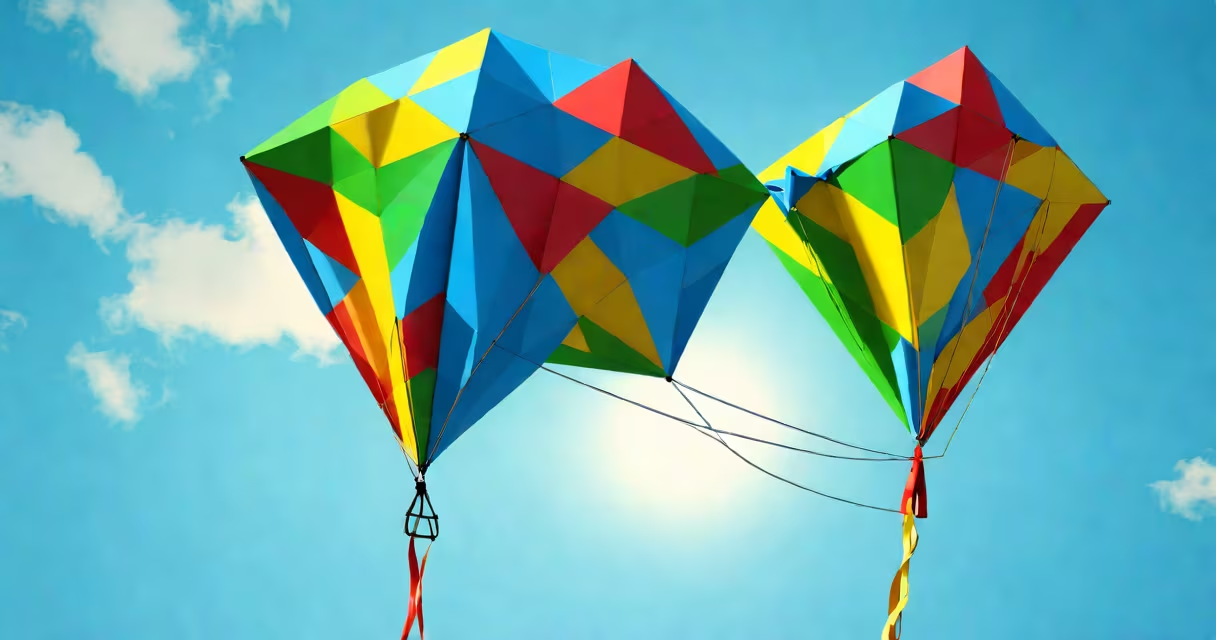
"Ready to fly" means your kite is fully assembled, checked for safety, and prepared for launch in suitable weather conditions. This includes verifying the kite's structure, attaching the bridle and tail, and ensuring the wind speed is ideal.
Flying a kite involves aerodynamics, where the wind pushes against the kite's surface, creating lift. The kite's design, including its shape and material, affects its stability and maneuverability. A properly flown kite balances these forces to stay aloft.
| Type | Description | Best For |
|---|---|---|
| Diamond Kite | Classic design with a triangular shape, easy to assemble and fly. | Beginners |
| Delta Kite | Stable and fast, shaped like the Greek letter delta. | Moderate winds |
| Box Kite | Three-dimensional design, often used for lifting small payloads. | Advanced flyers |
Kites are flown in open areas like parks, beaches, and fields where there are no obstructions. They are used for recreation, education, and even scientific purposes. For example, Benjamin Franklin used a kite to prove that lightning is a form of electricity.
Many people think kite flying is just about letting the wind do the work. However, it requires skill to control the kite's movements and adjust to changing wind conditions., not all kites are flown the same way. Some need specific techniques to launch and land safely.
I once tried flying a kite in a crowded urban area. The kite got tangled in trees and power lines, which was dangerous. Always choose an open space with steady wind for the best experience.
Before launching your kite, ensure all parts are securely attached. Check the wind direction and speed-ideal conditions are between 5 to 25 mph. Assemble the kite according to the manufacturer's instructions, and attach the bridle and tail. Ensure the flying line is free of knots and tangles.
Once ready, have a helper hold the kite while you walk backward to create tension in the line. Release the kite when it catches the wind and starts to lift. Adjust the bridle and tail as needed to maintain stability.
Always prioritize safety. Avoid flying near power lines, trees, or other obstructions. Keep a safe distance from other people and animals. If the wind becomes too strong or unpredictable, land the kite immediately.