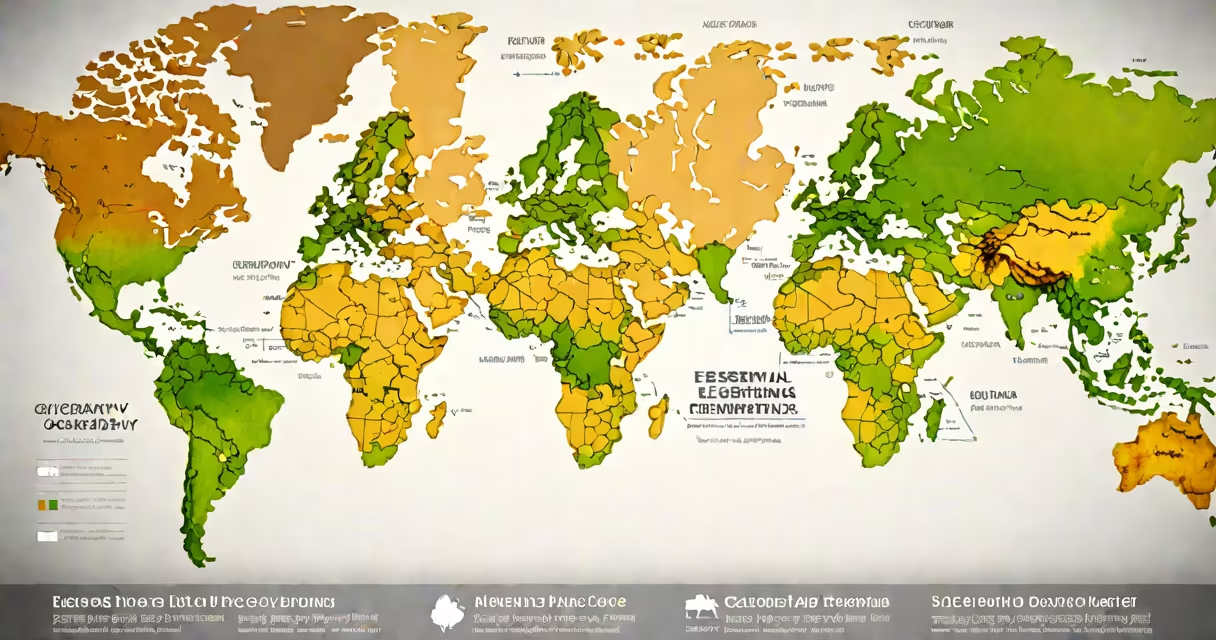
The six essential elements of geography are the fundamental concepts that explain how people, places, and environments interact: location, place, human-environment interaction, movement, region, and scale.
These elements form the foundation of geographic study, helping us understand the complex relationships between Earth's physical systems and human activities. For example, a geographer might analyze how climate (physical system) affects agriculture (human activity) in a specific region.
The six elements are:
Geographers use these elements to analyze everything from urban planning to global climate change. For instance, understanding regions helps policymakers allocate resources effectively. The U.S. Census Bureau applies these principles to map population distributions and plan infrastructure.
Many confuse geography solely with memorizing maps. However, it's a changing field studying patterns and processes shaping our world. Unlike history, which focuses on past events, geography examines spatial relationships and their impacts on the present and future.
One non-obvious fact: Scale isn't just about size-it also determines the level of detail. A local study might examine individual buildings, while a global study focuses on broad trends.
Consider New Orleans: Its location near the Gulf of Mexico makes it prone to hurricanes. The place combines French architecture and Mardi Gras culture. Human-environment interaction includes levees built to control flooding. Movement of people and goods relies on the port and highways. The city is part of the region known as the Deep South, characterized by humid subtropical climate and Creole cuisine. Finally, studying New Orleans at different scales reveals unique insights-from neighborhood resilience to its role in global trade routes.
I once used these elements to analyze my hometown's growth patterns, revealing how zoning laws (human-environment interaction) created distinct regions of residential and commercial areas.