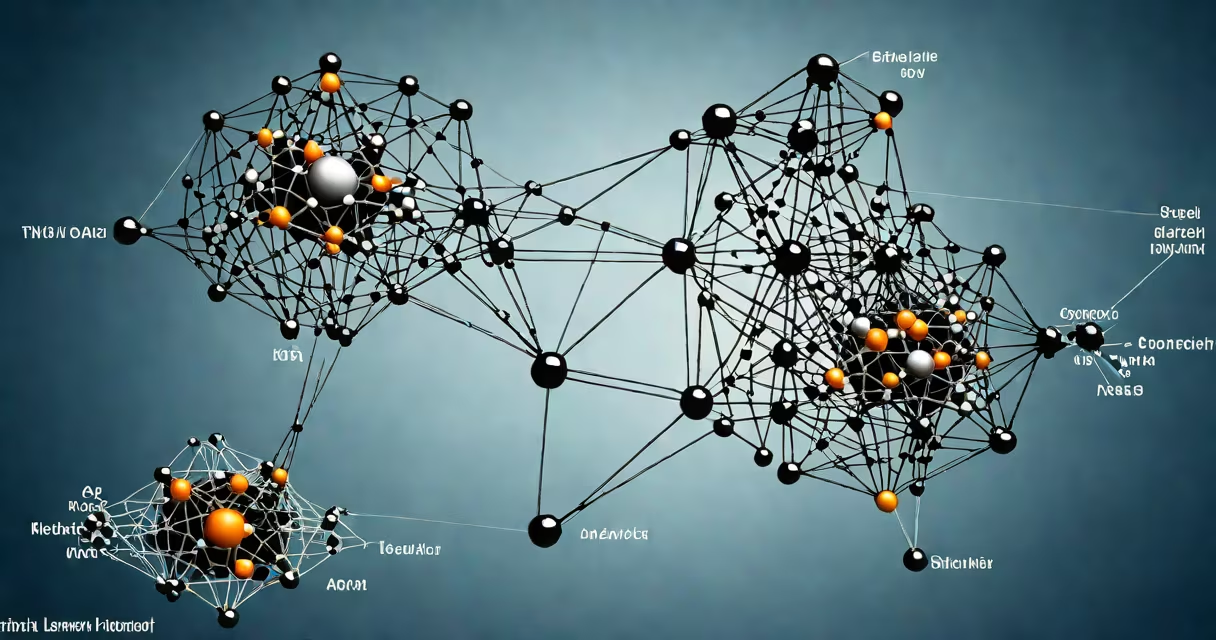
Training a deep learning model means feeding data through artificial neural networks to recognize patterns and make predictions. This process adjusts the model's internal parameters until it performs accurately on new data.
A deep learning model trains by processing input data through multiple layers of interconnected nodes, or neurons. Each neuron applies a mathematical function to the data, passing the result to the next layer. The model compares its output to the correct answer, then adjusts its parameters to reduce the error.
This adjustment happens through an algorithm called backpropagation. Backpropagation calculates how much each parameter contributed to the error, then changes those parameters slightly to minimize the error in the future. The model repeats this process many times, gradually improving its accuracy.
Deep learning models consist of three main components:
Each layer contains multiple neurons, and each neuron connects to every neuron in the next layer. The connections between neurons have weights, which the model adjusts during training.
People train deep learning models for various tasks, including image recognition, natural language processing, and predictive analytics. For example, a model might learn to recognize cats in photos or translate text from one language to another.
Training deep learning models requires significant computational power. Most models train on graphics processing units (GPUs) because GPUs handle parallel processing more efficiently than central processing units (CPUs).
The best GPUs for deep learning have high memory capacity and fast processing speeds. For instance, NVIDIA's A100 GPU offers 40 GB of memory and can perform 62 teraflops of floating-point operations per second. This capability allows the model to process large amounts of data quickly.
Some models train on specialized hardware like tensor processing units (TPUs), which Google designed specifically for machine learning tasks. TPUs offer even faster processing speeds than GPUs but are less common outside of research settings.
Training a deep learning model presents several challenges. One major challenge is the need for large amounts of labeled data. The model must see many examples of each category it needs to recognize. For example, a model learning to recognize cats might need thousands of photos of cats.
Another challenge is avoiding overfitting. Overfitting happens when the model learns the training data too well and performs poorly on new data. To prevent overfitting, researchers use techniques like regularization, dropout, and early stopping.
Finally, training deep learning models can be time-consuming and expensive. A single training session might take days or weeks, depending on the model's complexity and the amount of data. Researchers often use cloud-based services to access the necessary computational resources.
In my experience, training a deep learning model requires patience and attention to detail. I once trained a model to recognize handwritten digits using the MNIST dataset. The model took several hours to train on a consumer-grade GPU, but it achieved 98% accuracy on the test set. This success demonstrated the power of deep learning models to recognize complex patterns.
Training a deep learning model involves feeding data through artificial neural networks, adjusting the model's parameters to minimize error, and using useful hardware to speed up the process. Despite the challenges, deep learning models offer useful tools for solving complex problems in various fields. As hardware and algorithms improve, training these models will become faster and more accessible.