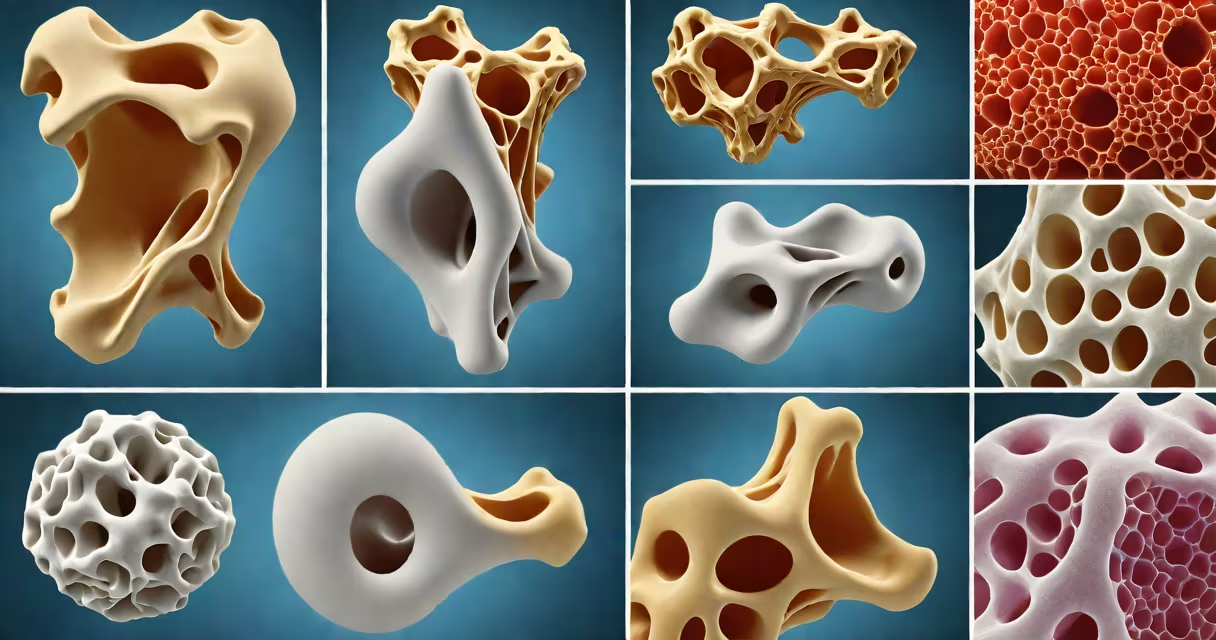
The three types of cartilage are hyaline cartilage, elastic cartilage, and fibrocartilage. These connective tissues differ in structure, function, and location in the body.
Cartilage is a flexible, semi-rigid connective tissue found throughout the body. It acts as a cushion between bones, reduces friction in joints, and provides structural support. Unlike bone, cartilage lacks blood vessels, relying on diffusion for nutrients.
The three types of cartilage are distinguished by their composition and function:
| Type | Composition | Function | Location |
|---|---|---|---|
| Hyaline Cartilage | Collagen fibers and chondrocytes in a gel-like matrix | Supports and cushions bones, reduces friction | Ends of long bones, ribs, nose, trachea |
| Elastic Cartilage | Elastic fibers and collagen fibers | Provides flexibility and support | Outer ear, epiglottis, auditory canal |
| Fibrocartilage | Dense collagen fibers and few chondrocytes | Absorbs shock and withstands pressure | Intervertebral discs, knee menisci, temporomandibular joint |
Each type of cartilage serves specific purposes based on its structure. Hyaline cartilage, the most common type, covers the ends of bones in movable joints, providing a smooth surface for movement. Elastic cartilage, with its high content of elastic fibers, maintains shape while allowing flexibility, important for structures like the outer ear. Fibrocartilage, the strongest type, absorbs shock in areas under heavy pressure, such as the intervertebral discs.
Many people confuse cartilage with bone or ligaments. While all three are connective tissues, they have distinct structures and functions. Bone contains living cells and blood vessels, making it harder and more rigid. Ligaments connect bone to bone, primarily composed of collagen fibers. Cartilage, however, is avascular and provides cushioning and support.
Another misconception is that cartilage cannot repair itself. While it heals slower than other tissues due to its lack of blood supply, cartilage can regenerate to some extent through the activity of chondrocytes, the cells embedded within its matrix.
Consider the knee joint, which experiences significant stress and movement. The ends of the femur and tibia are covered with hyaline cartilage to reduce friction during bending and extending. The meniscus, a C-shaped piece of fibrocartilage, absorbs shock and distributes weight evenly across the joint. Damage to the meniscus is common in athletes, highlighting the importance of fibrocartilage in maintaining joint stability.
I once observed a surgical procedure where a doctor repaired a torn meniscus. The fibrocartilage's dense collagen fibers were visible under the microscope, showcasing its tough, resilient nature. This firsthand experience reinforced my understanding of how each type of cartilage contributes to joint health and function.