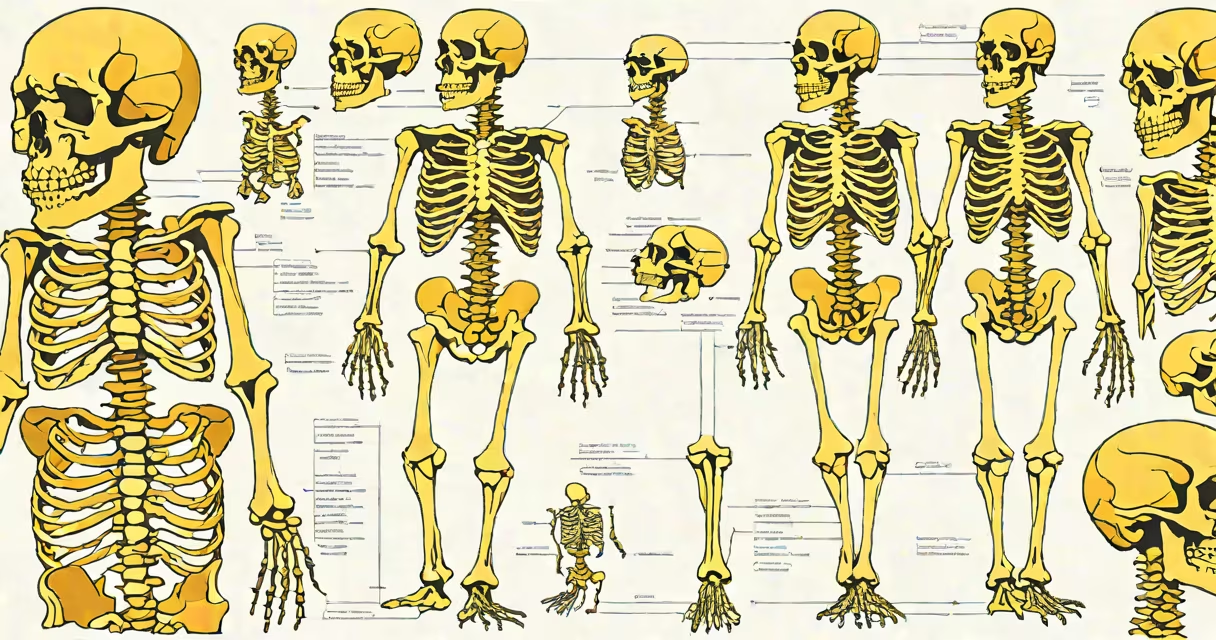
The structure of bones refers to their anatomical composition, including layers, cells, and minerals that form the skeletal system. Bones provide support, protection, and enable movement through their unique organization.
Bones consist of two main parts: compact bone and spongy bone. Compact bone forms the outer layer, offering strength and durability. Spongy bone fills the inner part, providing flexibility and reducing weight. Both types contain osteocytes, the living cells that maintain bone tissue.
Bones are classified into four primary types based on their shape and function:
| Type | Description | Examples |
|---|---|---|
| Long Bones | Longer than they are wide, with a shaft and two ends | Femur, humerus |
| Short Bones | Cube-shaped, providing stability and support | Carpals, tarsals |
| Flat Bones | Thin and flat, often protecting organs | Ribs, sternum |
| Irregular Bones | Various shapes, fitting complex roles | Vertebrae, hip bones |
Bones form the structure of the skeletal system, supporting the body and protecting important organs. They also serve as attachment points for muscles, enabling movement. Bones store minerals like calcium and phosphorus, releasing them into the bloodstream as needed.
Many people believe bones are rigid and unchanging. However, bones constantly remodel through a process called bone remodeling, where old bone tissue is replaced by new tissue. This process maintains bone strength and repair damage.
Another misconception is that all bones are solid. In reality, most bones contain a hollow center filled with bone marrow, which produces blood cells. This marrow is important for the immune system and blood production.
I once broke my arm and was surprised to learn that the healing process involved the formation of new bone tissue. The body's ability to repair bones showcases the changing nature of bone structure.
Unlike muscles, which are made of fibrous tissue and contract to enable movement, bones are rigid organs composed of mineralized tissue. While muscles provide force, bones provide structure and protection. Understanding the difference between these tissues is important for comprehending how the body functions.