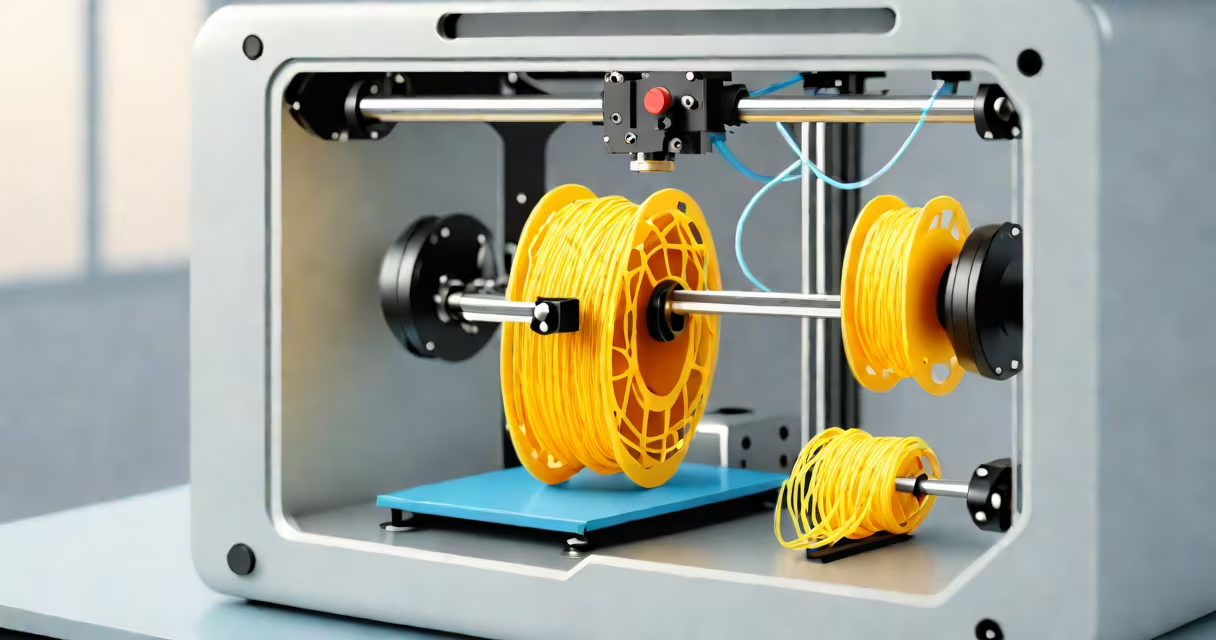
3D printing creates physical objects by building them layer by layer from digital models. The process begins with a 3D design file, which the printer reads to deposit material precisely where needed.
The most common method, called fused deposition modeling (FDM), uses a plastic filament that the printer melts and extrudes through a nozzle. The nozzle moves in precise patterns guided by the digital model, creating each layer before moving up slightly to start the next.
For example, printing a small plastic toy might take 30 minutes to several hours, depending on size and detail. The printer's nozzle traces the outline of each layer, then fills in the solid areas with a crisscross pattern. This builds the object from the bottom up, one thin layer at a time.
| Type | Material Used | Common Uses |
|---|---|---|
| FDM (Fused Deposition Modeling) | Thermoplastics (PLA, ABS) | Prototypes, toys, household items |
| SLA (Stereolithography) | Resins | Dental models, jewelry, detailed miniatures |
| SLS (Selective Laser Sintering) | Nylon powder | Industrial parts, aerospace components |
3D printing is used in industries. Hospitals use it to create custom prosthetics, while aerospace companies print lightweight, complex parts that reduce aircraft weight. Even in education, schools use 3D printers to teach engineering and design principles.
A common misconception is that 3D printing is only for prototyping. However, many businesses now use it for final production runs, especially for customized or low-volume products. For instance, a company might print custom-fit earbuds using scans of a customer's ears, something impossible with traditional manufacturing methods.
People often confuse 3D printing with other forms of additive manufacturing, such as CNC machining. Unlike 3D printing, CNC machining removes material from a solid block to create the desired shape. This subtractive process is faster for certain tasks but lacks the flexibility of 3D printing for complex geometries.
Another confusion arises with resin printing, often called stereolithography (SLA). While SLA uses light to cure liquid resin into solid layers, it differs from FDM printing, which uses melted plastic filaments. Each method has unique strengths and limitations, making them suitable for different applications.
When I first used a 3D printer, I was surprised by how quiet and unobtrusive the process was. Unlike traditional manufacturing equipment, the printer operated with minimal noise, emitting only a soft whirring sound as it moved the nozzle. The smell of melting plastic was faint, and the entire process was surprisingly clean, with no excess material to clean up afterward.
I printed a small gear design to test the printer's accuracy. The gear turned out perfectly, with smooth edges and precise dimensions. This hands-on experience showed me how accessible 3D printing has become, even for hobbyists and small businesses.
3D printing transforms digital designs into physical objects by building them layer by layer. Whether used for prototyping, custom manufacturing, or educational purposes, it offers unique flexibility and precision. Understanding what 3D printing looks like helps demystify this new technology and its growing role in various industries.