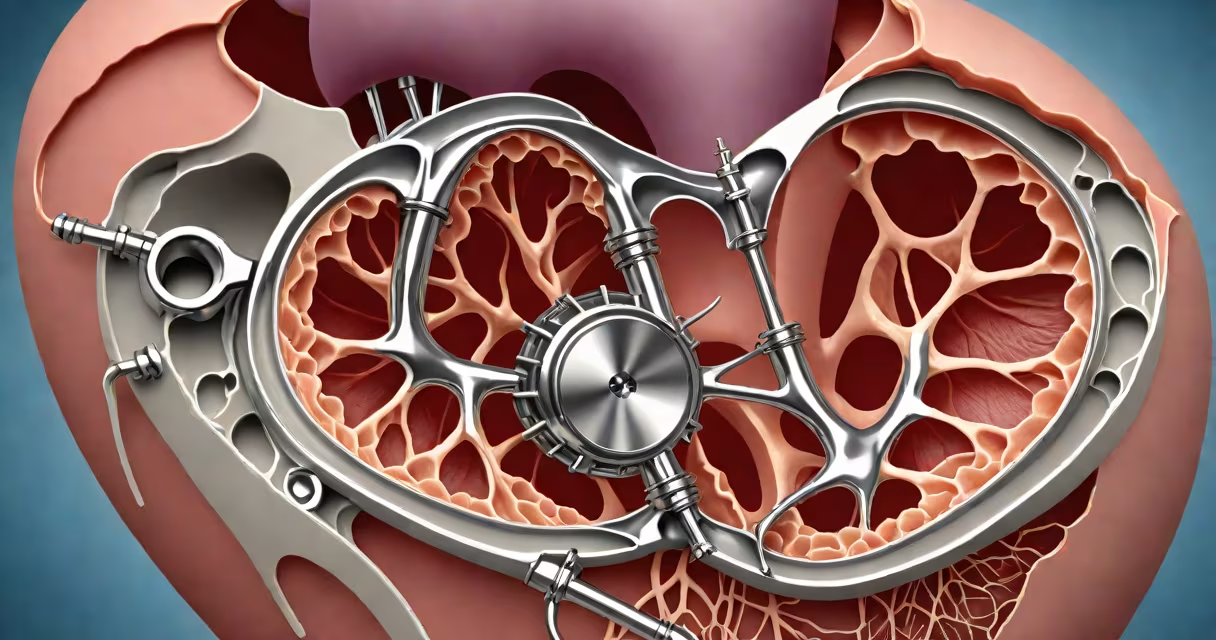
The mitral valve is a two-flap (bicuspid) valve located between the left atrium and left ventricle of the heart. It resembles a pair of parachutes or sailboats when viewed from above.
The mitral valve opens to allow blood to flow from the left atrium into the left ventricle and closes to prevent backflow when the ventricle contracts. Its two leaflets (anterior and posterior) are supported by tendinous cords connected to papillary muscles in the ventricle wall.
| Component | Description |
|---|---|
| Leaflets | Two thin, flexible flaps (anterior and posterior) |
| Annulus | Fibrous ring anchoring the leaflets |
| Chordae Tendineae | Tendinous cords connecting leaflets to papillary muscles |
| Papillary Muscles | Muscle groups in the ventricle wall that contract to tighten chords |
The mitral valve sits between the left atrium (which receives oxygenated blood from the lungs) and the left ventricle (which pumps blood to the body). During diastole (heart relaxation), it opens to allow blood flow. During systole (heart contraction), it closes to prevent regurgitation into the atrium.
A healthy mitral valve allows unidirectional blood flow while preventing leakage. The American Heart Association notes that proper valve function is important for maintaining efficient circulation.
Many confuse the mitral valve with the aortic valve, which has three cusps and sits between the left ventricle and aorta. Unlike the mitral valve, the aortic valve doesn't have chordae tendineae.
Another mistake is assuming all heart valves are tricuspid. Only the aortic, pulmonary, and tricuspid valves have three leaflets; the mitral valve uniquely has two.
Imagine holding two small parachutes by their strings. When you pull the strings, the parachutes close tightly. This mimics how the mitral valve's leaflets close during ventricular contraction, prevented backflow by tightening the chordae tendineae.
Mitral valve disorders include prolapse (leaflets bulge backward) and stenosis (leaflets thicken and narrow). The Mayo Clinic reports that mitral valve prolapse affects about 2% of the population, often causing a clicking sound during heartbeat.