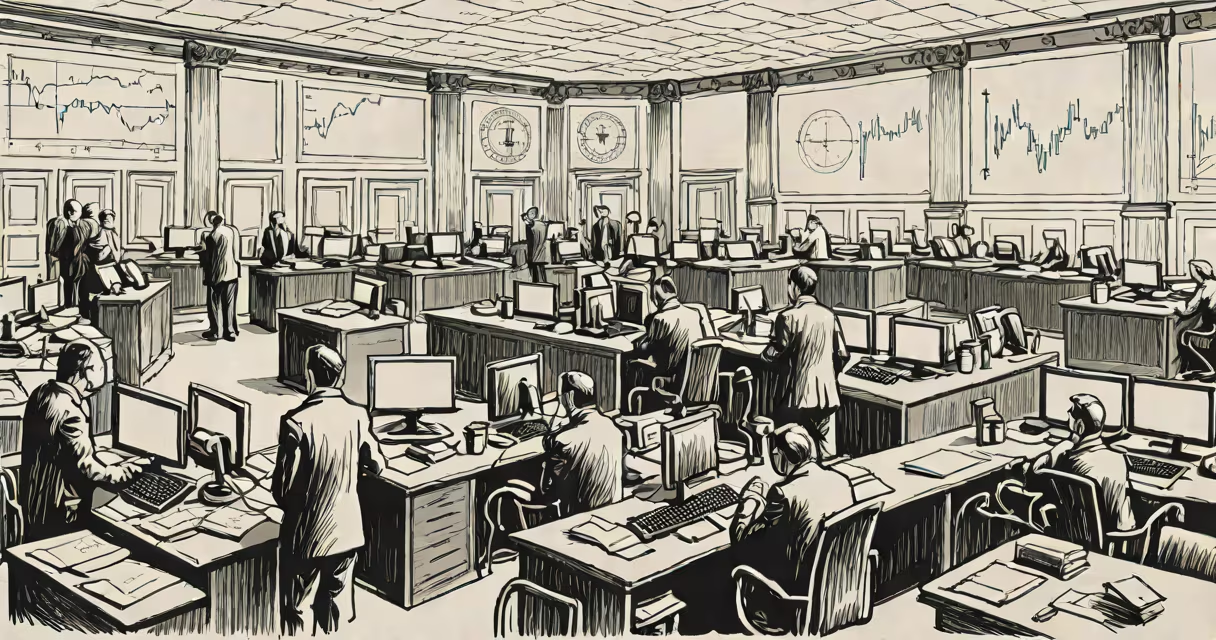
Capital markets are financial systems where businesses raise long-term funds and investors trade high-value assets like stocks and bonds. These markets help the flow of capital between savers and users, driving economic growth.
Capital markets operate through primary and secondary markets. In the primary market, new securities are issued and sold to investors. For example, when a company conducts an initial public offering (IPO), it raises capital by selling shares to the public for the first time. In the secondary market, existing securities are traded among investors. The New York Stock Exchange (NYSE) and Nasdaq are prominent examples of secondary markets.
Capital markets are broadly divided into two categories: equity markets and debt markets.
| Type | Description | Examples |
|---|---|---|
| Equity Markets | Markets where shares of companies are issued and traded. Investors buy and sell ownership stakes in corporations. | NYSE, Nasdaq, London Stock Exchange |
| Debt Markets | Markets where debt instruments like bonds are issued and traded. Investors lend money to governments or corporations in exchange for periodic interest payments and the return of the principal at maturity. | U.S. Treasury bonds, corporate bonds, municipal bonds |
Capital markets are used globally to support economic activities. Governments and corporations use these markets to finance large projects, such as infrastructure development or business expansion. Investors use capital markets to grow their wealth by investing in securities that offer potential returns. For instance, a tech startup might issue shares in the equity market to raise capital for research and development, while a municipality might issue bonds in the debt market to fund a new school.
One common misconception is that capital markets are only for large corporations. In reality, small and medium-sized enterprises (SMEs) also access capital markets through specialized platforms and private equity investments., capital markets are often confused with money markets, which deal with short-term debt instruments like treasury bills and commercial paper. Unlike capital markets, money markets focus on short-term funding needs rather than long-term investments.
Another misconception is that capital markets are purely speculative. While there is an element of risk and speculation, these markets play a important role in economic stability and growth by allocating resources efficiently. According to the World Bank, well-functioning capital markets contribute to economic development by providing the necessary funds for productive investments.
During my tenure at a financial advisory firm, I witnessed how capital markets facilitated the expansion of a renewable energy company. By issuing green bonds in the debt market, the company raised $500 million to build new solar farms. This investment contributed to sustainable energy development, demonstrating the real-world impact of capital markets.
Capital markets are important components of the global economy, enabling businesses to grow and investors to achieve their financial goals. By understanding how these markets function and their various applications, individuals and organizations can make informed decisions to drive economic progress.