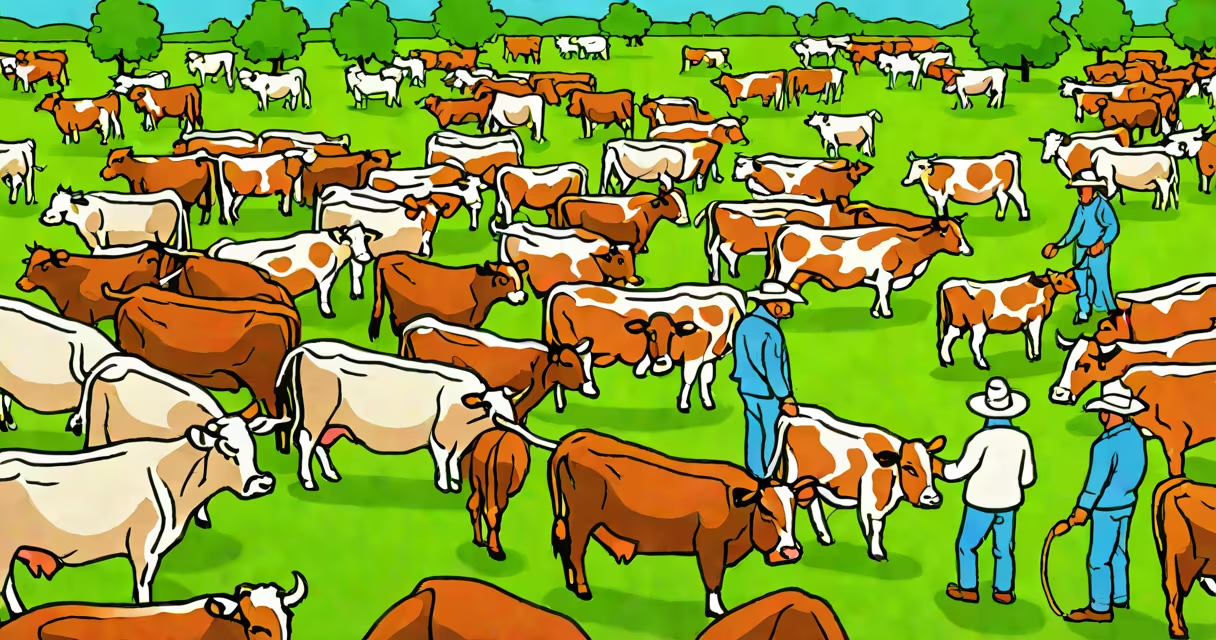
EPD stands for "expected progeny differences," a statistical tool measuring how offspring of a specific cattle parent will perform compared to offspring of other parents. It helps breeders select animals based on genetic potential.
EPDs quantify genetic merit by comparing an animal's performance to a population average. A positive EPD indicates an animal's offspring will outperform the average, while a negative EPD suggests they'll underperform. For example, a bull with a +50 pound weaning weight EPD will sire calves that weigh 50 pounds more at weaning than calves from average bulls.
| Trait | Description |
|---|---|
| Birth Weight (BW) | Predicts calf birth weight, important for avoiding calving difficulties. |
| Weaning Weight (WW) | Estimates weight at weaning (typically 205 days), indicating growth efficiency. |
| Yearling Weight (YW) | Projects weight at one year, useful for evaluating mature size potential. |
| Caracas Weight (CW) | Estimates weight at harvest, important for meat yield predictions. |
| Marbling (IMF) | Measures intramuscular fat, a key factor in beef quality grading. |
EPDs enable precise genetic selection, accelerating improvement of desirable traits. The American Simmental Association reports breeders using EPDs achieve 1.5 times faster genetic progress than those relying on visual appraisal alone. By selecting bulls with high growth and marbling EPDs, producers can improve both efficiency and beef quality.
I've seen this firsthand at local ranches where breeders cross-reference EPDs with pedigree information to make informed mating decisions. For instance, pairing a bull with excellent marbling EPDs to cows with high milk production EPDs can create offspring that excel in both areas.
Many confuse EPDs with actual performance measurements. Unlike recording an animal's weight, EPDs are predictions based on statistical models. They account for environmental factors and genetic relationships, providing a more accurate assessment of genetic potential than raw data.
Another mistake is assuming higher EPD values are always better. While this holds true for growth traits, lower values may be preferable for birth weight to prevent calving issues. Breeders must balance multiple EPDs to achieve herd improvement.
EPDs result from complex statistical analyses combining an animal's performance records with those of relatives. The American Hereford Association uses a system called single-step genomic evaluation, incorporating DNA information for greater accuracy. This method considers thousands of genetic markers to refine EPD predictions, especially for young animals with limited performance data.
For a concrete example, consider calculating weaning weight EPD. The process involves:
This rigorous approach ensures EPDs reliably reflect genetic differences between animals, making them invaluable tools for modern cattle breeding programs.