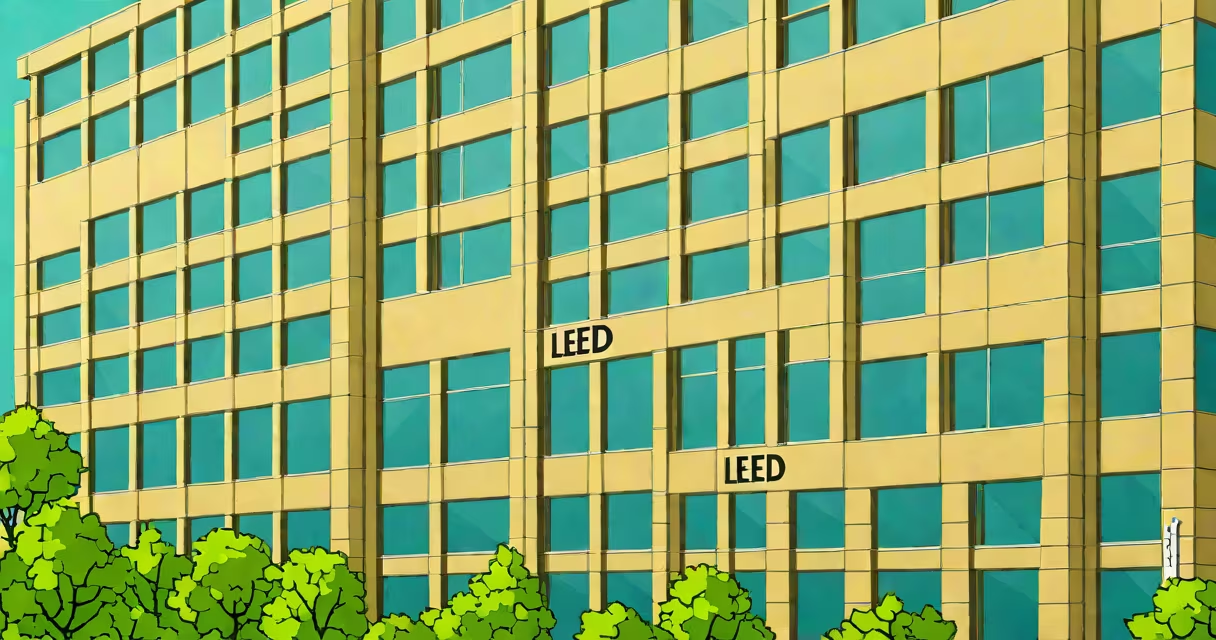
LEED accreditation certifies professionals who demonstrate expertise in designing, constructing, and maintaining energy-efficient, eco-friendly buildings according to the Leadership in Energy and Environmental Design (LEED) rating system. The U.S. Green Building Council (USGBC) administers the program.
The LEED accreditation process begins with passing the LEED Green Associate exam, which covers basic concepts of green design, construction, and operations. After earning the Green Associate credential, professionals can pursue specialized accreditations like LEED AP BD+C (Building Design and Construction) or LEED AP O+M (Operations and Maintenance).
Candidates must study the LEED rating system, which evaluates buildings across five key areas: sustainable sites, water efficiency, energy and atmosphere, materials and resources, and indoor environmental quality. For example, a LEED AP BD+C specialist might focus on optimizing a building's location to reduce urban sprawl while preserving natural habitats.
| Credential | Focus Area | Exam Length |
|---|---|---|
| LEED Green Associate | General green building principles | 2 hours |
| LEED AP BD+C | Building design and construction | 2 hours |
| LEED AP O+M | Building operations and maintenance | 2 hours |
| LEED AP ND | Neighborhood development | 2 hours |
LEED accreditation ensures professionals understand how to minimize a building's environmental impact. For instance, a LEED AP O+M specialist might implement strategies to reduce water usage by 30% compared to conventional buildings, as required by certain LEED credits. According to the USGBC, LEED-certified buildings use 25% less energy and emit 34% fewer greenhouse gases than typical structures.
Many governments and organizations mandate LEED certification for new constructions. For example, New York City requires all new buildings over 25,000 square feet to meet LEED Gold standards. Professionals with LEED accreditation gain a competitive edge in the job market, as employers increasingly prioritize sustainability expertise.
Some believe LEED accreditation is only for architects and engineers, but it applies to various roles, including project managers, contractors, and facility managers. Others assume LEED certification is expensive, but the cost varies by project size and complexity. A small office renovation might achieve LEED certification for under $5,000, while a large commercial building could require a $50,000 investment.
Another misconception is that LEED certification is optional. However, many local governments mandate it for public buildings. For example, California requires all state-owned buildings to meet LEED Silver standards.
Unlike LEED, which emphasizes environmental performance, other building certifications like WELL focus on occupant health and well-being. WELL-certified buildings prioritize air quality, lighting, and ergonomics, whereas LEED emphasizes energy efficiency and sustainability.
I worked on a LEED Gold-certified office building in Chicago. The project team included a LEED AP BD+C professional who ensured the building met strict energy efficiency standards. They selected low-emissivity windows to reduce heat transfer, installed a rainwater harvesting system to cut water usage by 40%, and used recycled materials for construction. The result was a 30% reduction in energy costs compared to conventional buildings.