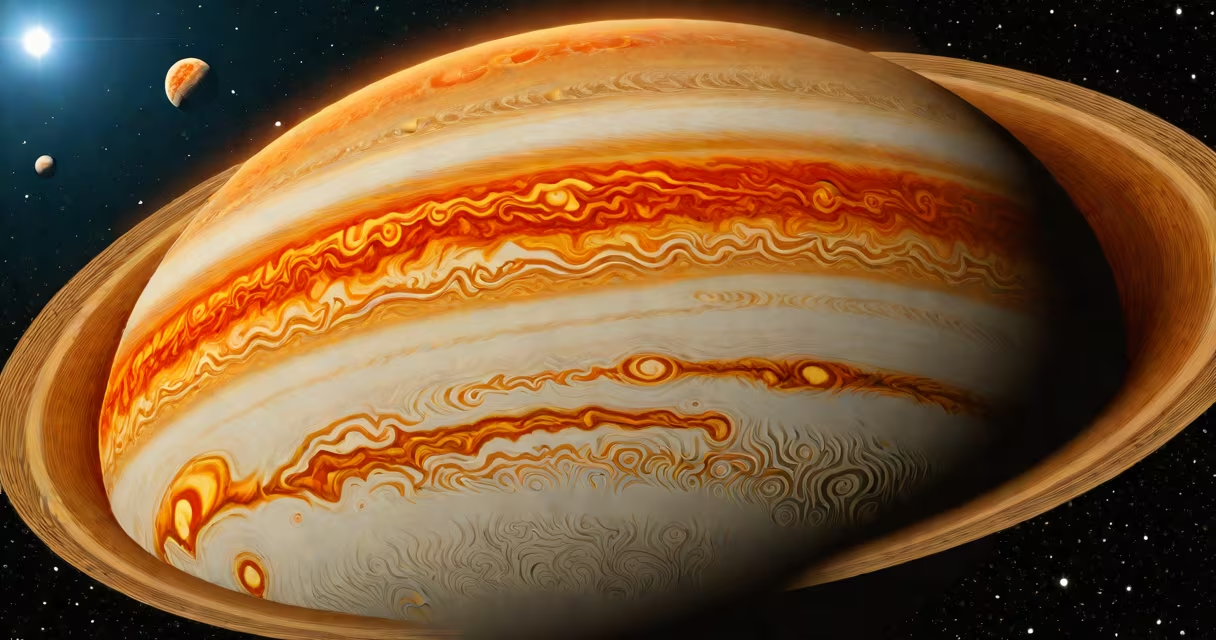
Jupiter is the largest planet in our solar system, with a diameter of about 86,881 miles (139,820 kilometers) at its equator. This gas giant is so massive that over 1,300 Earths could fit inside it.
Jupiter's volume is 1,321 Earths, making it the most voluminous planet in our solar system. Its mass is more than twice that of all other planets combined. For perspective, if you gathered all the material from every other planet, Jupiter would still weigh more.
Jupiter is classified as a gas giant, composed mostly of hydrogen and helium. Unlike rocky planets, it lacks a solid surface. The planet's most famous feature is the Great Red Spot, a storm larger than Earth that has raged for centuries.
The planet's atmosphere is divided into distinct cloud bands, with winds reaching speeds of up to 400 mph (644 km/h). Jupiter also has the strongest magnetic field of any planet, with a magnetosphere so large it begins deflecting solar wind 3 million miles (4.8 million kilometers) toward the sun.
Jupiter orbits the Sun at an average distance of 484 million miles (778 million kilometers), taking about 12 Earth years to complete one orbit. Its immense gravity is important for shaping our solar system. Jupiter's gravitational influence helps clear debris from the asteroid belt, preventing potential impacts on inner planets like Earth.
Many people mistakenly believe Jupiter is a failed star. While it emits some heat, it does not undergo nuclear fusion like stars. Others think Jupiter has a solid surface, but it is entirely gaseous with increasing pressure and density toward the core.
Another misconception is that Jupiter's Great Red Spot is a permanent, unchanging feature. In reality, it has been shrinking and changing shape over time. Recent observations show it is now more oval than circular.
During a public astronomy event, I had the chance to observe Jupiter through a high-powered telescope. Seeing the distinct cloud bands and the Great Red Spot was awe-inspiring. The clarity of the image revealed details that are often missed in standard photographs, highlighting the changing nature of this gas giant.
Jupiter's dominance in size and influence makes it a fascinating subject of study. Its role in protecting inner planets and its complex weather systems offer valuable insights into planetary science. Understanding Jupiter helps us appreciate the diversity and dynamics of our solar system.