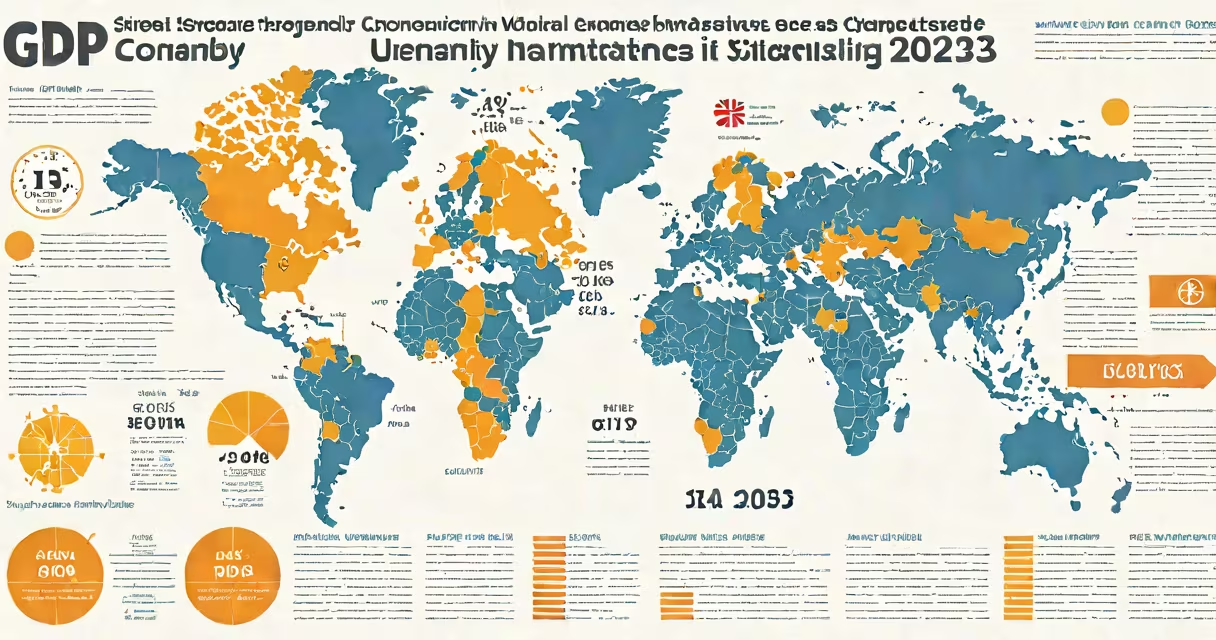
The strongest economy in the world is the United States, with a nominal GDP of $26.95 trillion in 2023. This ranking is based on gross domestic product (GDP), the total market value of goods and services produced in a country.
Economists measure economic strength using several key indicators. The most common is GDP, which reflects the size and output of an economy. Other important metrics include GDP per capita, economic growth rate, and purchasing power parity (PPP). The International Monetary Fund (IMF) and the World Bank publish annual reports on global GDP rankings.
Economies are ranked by their GDP, either nominal or adjusted for PPP. Nominal GDP compares economies at current exchange rates, while PPP adjusts for differences in cost of living. For example, China's economy ranks second in nominal GDP but first in PPP-adjusted GDP.
GDP per capita measures average income and standard of living. Luxembourg, Ireland, and Switzerland rank highest in GDP per capita, reflecting their high-income economies. Economic growth rate indicates how quickly an economy is expanding. The World Bank tracks these metrics annually.
| Rank | Country | Nominal GDP (2023) | GDP per Capita (2023) |
|---|---|---|---|
| 1 | United States | $26.95 trillion | $82,690 |
| 2 | China | $17.73 trillion | $12,556 |
| 3 | Japan | $4.23 trillion | $33,759 |
| 4 | Germany | $4.44 trillion | $52,171 |
| 5 | India | $3.71 trillion | $2,600 |
Beyond GDP, other economic indicators show a country's economic health. These include unemployment rates, inflation, trade balances, and foreign direct investment (FDI). For instance, the U.S. has a low unemployment rate of 3.7% in 2023, indicating a strong labor market.
Inflation measures price changes over time. The European Central Bank aims for 2% annual inflation, while the U.S. Federal Reserve targets the same rate. Trade balances show whether a country exports more than it imports. Germany, for example, has a positive trade balance due to its strong manufacturing sector.
Many confuse economic strength with population size. While China has the largest population, its GDP per capita is lower than the U.S., meaning average incomes are higher in America. Similarly, small countries like Luxembourg have high GDP per capita but low GDP due to their tiny populations.
Another misconception is equating economic strength with resource wealth. Countries like Saudi Arabia have significant oil reserves but rely heavily on a single industry. Diversified economies, such as the U.S. and Germany, are more resilient to economic shocks.
When I visited Germany in 2022, I noticed its advanced manufacturing sector firsthand. German cars, machinery, and industrial equipment are exported globally, contributing to its strong economy. This aligns with Germany's high ranking in both nominal GDP and GDP per capita.
The U.S. economy benefits from innovation and a large consumer market. Tech giants like Apple and Amazon drive growth, while the U.S. dollar remains the world's reserve currency. These factors contribute to its status as the strongest economy.
Understanding economic strength requires looking beyond simple rankings. GDP, GDP per capita, economic growth, and diversification all play important roles. For deeper insights, explore how economists define the economy.