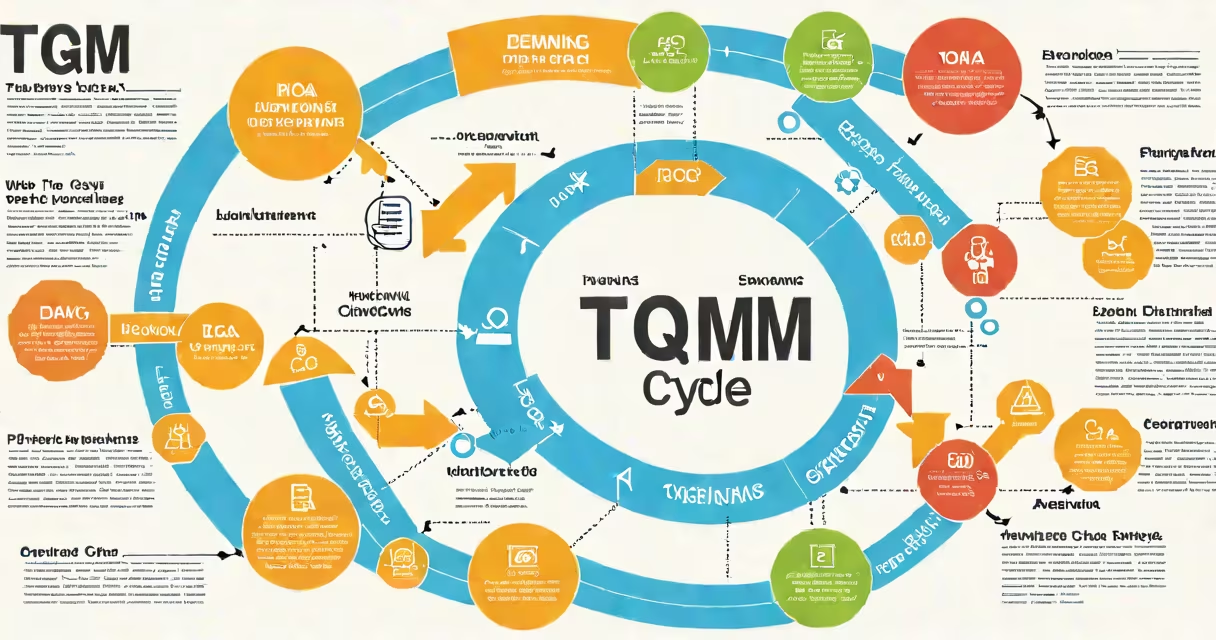
Total Quality Management (TQM) is a long-term approach to improving products and services through continuous feedback, employee involvement, and customer satisfaction.
TQM operates on several core principles:
The Deming Cycle (Plan-Do-Check-Act) is often used in TQM. For example, a manufacturing company might plan to reduce defects, implement changes (Do), measure results (Check), and standardize successful changes (Act).
Common tools used in TQM include:
TQM is used across industries,. It's particularly valuable in environments where consistency and quality are critical. For instance, Toyota implemented TQM principles to achieve near-perfect production efficiency.
Companies use TQM to reduce waste, improve efficiency, and improve customer satisfaction. A study by the American Society for Quality found that organizations using TQM principles saw a 20-30% reduction in costs and a significant increase in customer satisfaction.
One common misconception is that TQM is only about quality control. In reality, it's a complete approach that involves all aspects of an organization, including management, employees, and processes. Another mistake is thinking TQM is a one-time project. It's an ongoing effort that requires continuous commitment.
TQM is often confused with Six Sigma, another quality management methodology. While both focus on quality improvement, Six Sigma is more statistical and data-driven, whereas TQM is broader and more inclusive of all organizational aspects.
In my experience working with a software development team, we implemented TQM principles to improve our product quality. We started by gathering customer feedback (customer focus), mapped out our development process (process-centered), and continuously tested and improved our software (continuous improvement). The result was a 40% reduction in reported bugs and a significant increase in customer satisfaction.
For more on how mathematical principles apply to quality management, see how "by" in math means proportional relationships.