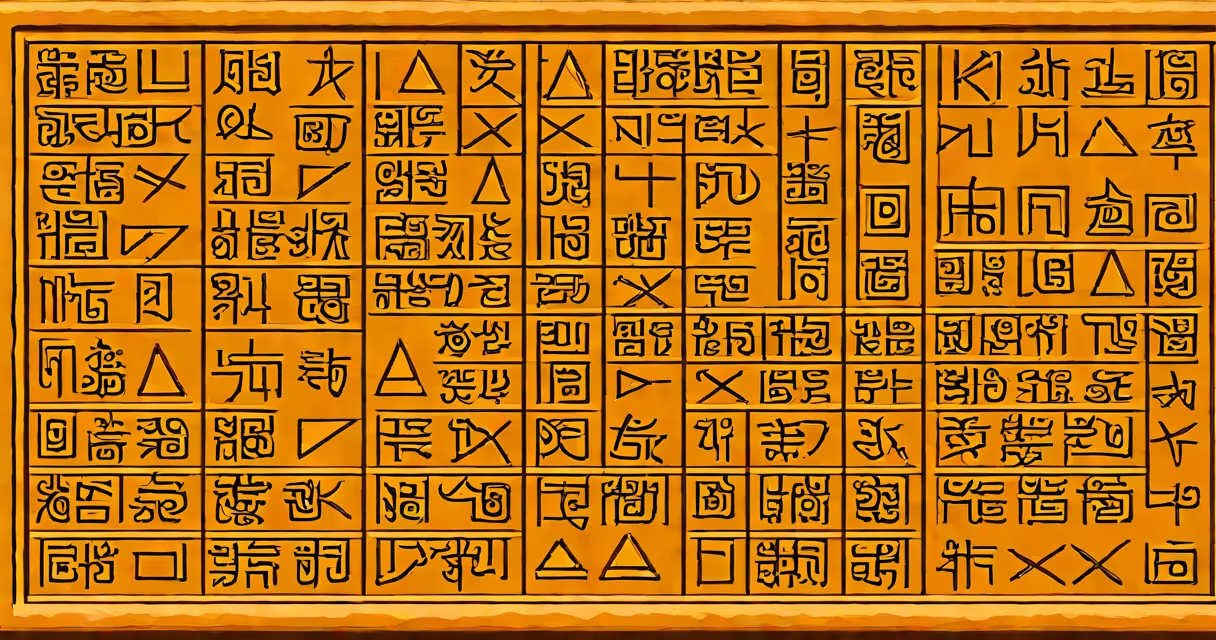
Mathematics wasn't invented by a single person but developed over millennia through contributions from multiple ancient civilizations. The earliest mathematical records appear around 3000 BCE in Mesopotamia, with later advancements from Egypt, Greece, India, and the Islamic world.
The earliest known mathematical artifacts are clay tablets from Sumer in southern Mesopotamia, dating to 2600 BCE. These contain arithmetic tables and geometric calculations. Around the same time, ancient Egyptians developed mathematics for practical purposes like tax collection and building projects.
These early systems focused on practical applications like commerce, architecture, and astronomy rather than theoretical exploration. The Rhind Mathematical Papyrus (c. 1550 BCE) shows Egyptian mathematics included arithmetic, algebra, and geometry problems.
| Name | Time Period | Key Contribution |
|---|---|---|
| Imhotep | c. 2650-2600 BCE | Designed the Step Pyramid at Saqqara, demonstrating advanced mathematical understanding |
| Thales of Miletus | c. 624-546 BCE | First recorded Western philosopher to apply mathematics to astronomy |
| Pythagoras | c. 570-495 BCE | Discovered the Pythagorean theorem and properties of numbers |
| Euclid | c. 300 BCE | Author of Elements, the most influential math textbook in history |
The Greeks transformed mathematics from a practical tool into a theoretical science. Around 300 BCE, Euclid compiled existing knowledge into his 13-volume work Elements, which became the foundation of Western mathematics. This work introduced formal proofs and axioms, creating a systematic structure still used today.
Archimedes (c. 287-212 BCE) made significant advances in geometry, calculus, and the understanding of pi. His method of exhaustion anticipated integral calculus by over 2,000 years. Unlike earlier civilizations, Greek mathematicians sought abstract truths rather than just practical solutions.
Many people assume mathematics was invented by a single culture or individual. In reality, it emerged independently in multiple civilizations. The Babylonians had a base-60 number system (which we still use for time and angles), while the Mayans developed a base-20 system.
Another myth is that ancient mathematics was primitive. The Antikythera mechanism, a 2nd-century BCE Greek device, functioned as an advanced astronomical calculator with differential gearing, demonstrating sophisticated mathematical understanding.
Today, we recognize that mathematics evolved through cumulative contributions. The bachelor of science in mathematics curriculum covers these historical developments alongside modern concepts. Understanding this history helps contextualize current mathematical research and education.
While no single person invented mathematics, the collective efforts of ancient civilizations created the foundations upon which modern mathematics stands. Their practical tools and theoretical breakthroughs continue to influence mathematics and related fields today.