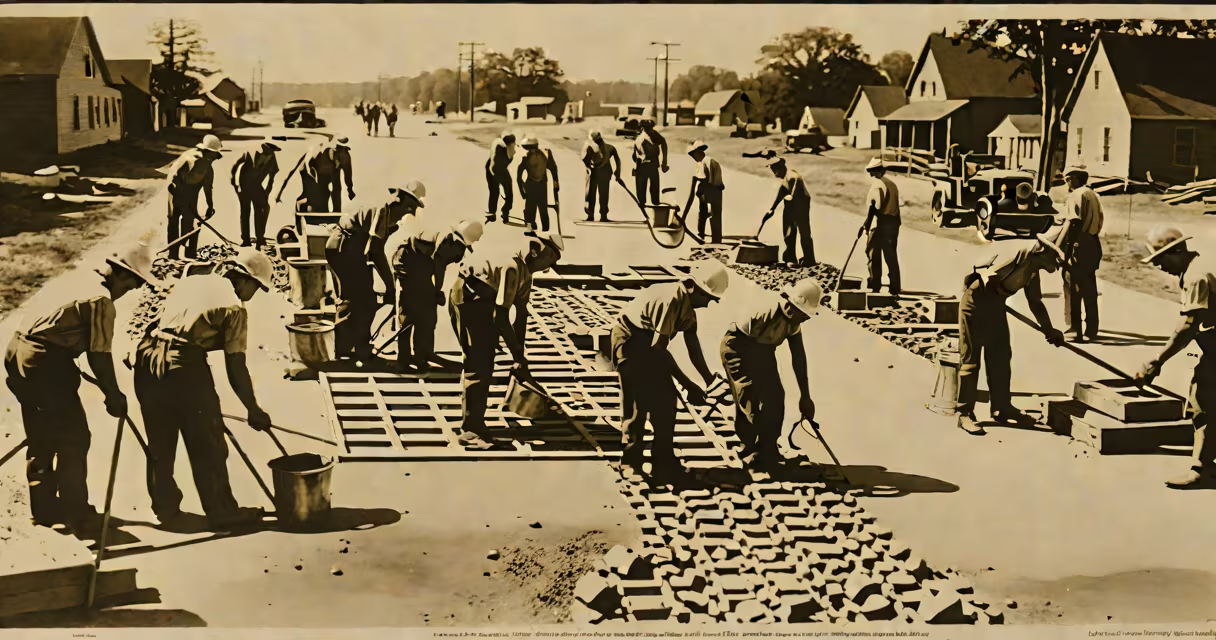
The Works Progress Administration (WPA) was a U.S. government agency created in 1935 that employed millions of people to carry out public works projects during the Great Depression. It was the largest New Deal agency, employing over 8 million workers at its peak.
The WPA provided jobs to unemployed Americans, primarily those who were unskilled. Workers were paid minimum wages, which helped stimulate local economies. Projects ranged from constructing roads and bridges to building schools, hospitals, and parks. The WPA also supported arts and cultural programs, including theater productions and art projects.
| Project Type | Examples | Number of Projects |
|---|---|---|
| Transportation | Roads, bridges, airports | 165,000 |
| Education | Schools, libraries | 5,000 |
| Public Health | Hospitals, water systems | 1,500 |
| Arts and Culture | Theater, art, music | 170,000 |
The WPA was established to provide employment and economic stability during the Great Depression. President Franklin D. Roosevelt created it as part of his New Deal programs to combat unemployment and poverty. The WPA's projects improved infrastructure and public services across the country.
One common misconception is that the WPA was solely focused on construction projects. While construction was a significant part of its work, the WPA also supported arts and cultural programs, which are often overlooked. Another misconception is that the WPA was a temporary solution. Although it was created to address immediate needs, many of its projects had long-lasting benefits.
The WPA's impact is still visible today. Many of the roads, bridges, schools, and parks built by the WPA are still in use. The agency's focus on public works and infrastructure set a precedent for future government programs aimed at addressing unemployment and improving public services.
For example, the WPA built the San Francisco-Oakland Bay Bridge, which remains a critical transportation link. The agency also constructed over 800 airports, many of which are still operational today. These projects created infrastructure that continues to serve communities across the United States.
In my research, I came across a lesser-known fact: the WPA employed women and minorities, providing them with opportunities that were otherwise scarce during the Great Depression. This inclusive approach was ahead of its time and contributed to the agency's lasting legacy.