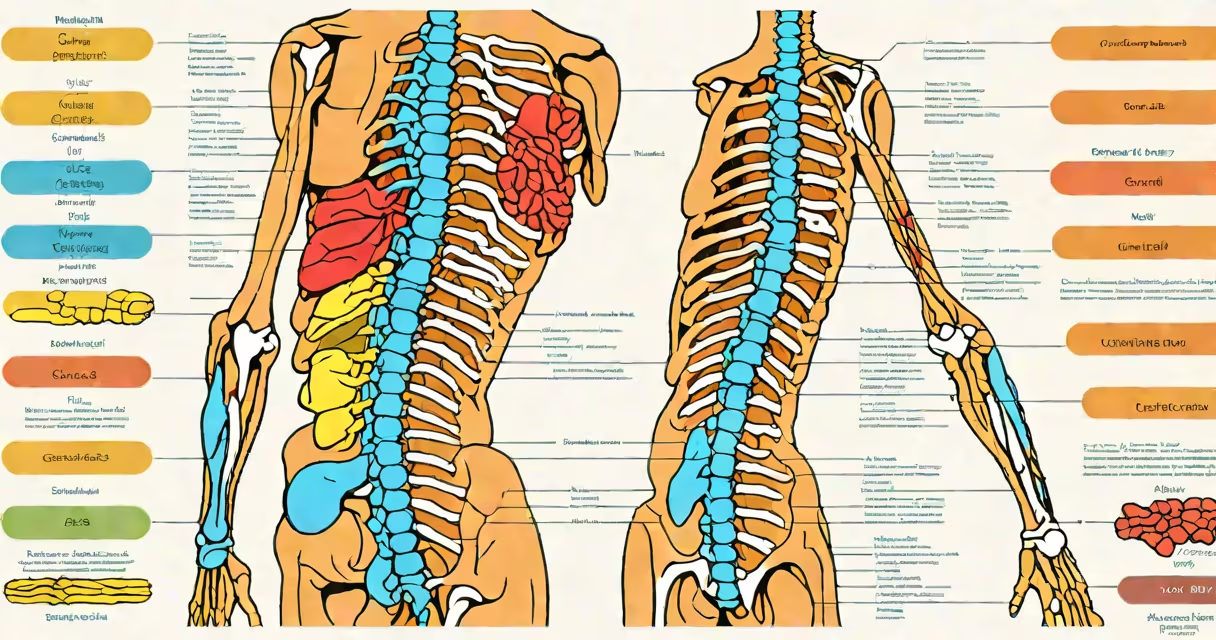
The anatomy of spine consists of 33 vertebrae divided into five regions, the spinal cord running through them, and supporting structures like intervertebral discs and ligaments. This complex structure provides support, protection, and flexibility.
The spine forms the central axis of the skeleton. It supports the head and trunk, protects the spinal cord, and allows movement. The spine consists of vertebrae, spinal cord, intervertebral discs, and ligaments.
The spine has 33 vertebrae grouped into five regions:
| Region | Number of Vertebrae | Characteristics |
|---|---|---|
| Cervical | 7 | Supports the head, allows rotation and flexion |
| Thoracic | 12 | Attaches to ribs, protects organs, limited mobility |
| Lumbar | 5 | Bears most weight, flexible for movement |
| Sacral | 5 (fused) | Forms the sacrum, connects to pelvis |
| Coccygeal | 4 (often fused) | Rudimentary tailbone, minimal function |
The first seven cervical vertebrae form the neck. The first cervical vertebra (C1) supports the skull. The second cervical vertebra (C2) has a unique shape allowing head rotation. The thoracic vertebrae connect to ribs, protecting important organs. The lumbar vertebrae bear most of the body's weight. The sacral vertebrae fuse into the sacrum, connecting to the pelvis. The coccygeal vertebrae form the vestigial tailbone.
Intervertebral discs sit between vertebrae, acting as shock absorbers. They consist of a fibrous outer ring and a gel-like center. Ligaments connect vertebrae, providing stability. Muscles attach to the spine, enabling movement and posture maintenance.
The spinal cord runs through the vertebral column, protected by vertebrae. It transmits signals between the brain and body. The spinal cord ends around the first or second lumbar vertebra in adults, forming the conus medullaris.
Many believe the spine has only 26 vertebrae, ignoring the fused sacral and coccygeal bones. Others think the spine is rigid, but it's highly flexible due to intervertebral discs and joints. Some assume all vertebrae are alike, but they vary in size and shape.
I once observed a spinal surgery where doctors carefully navigated these structures, highlighting the complexity of spinal anatomy. Understanding this anatomy is important for diagnosing and treating spinal conditions.