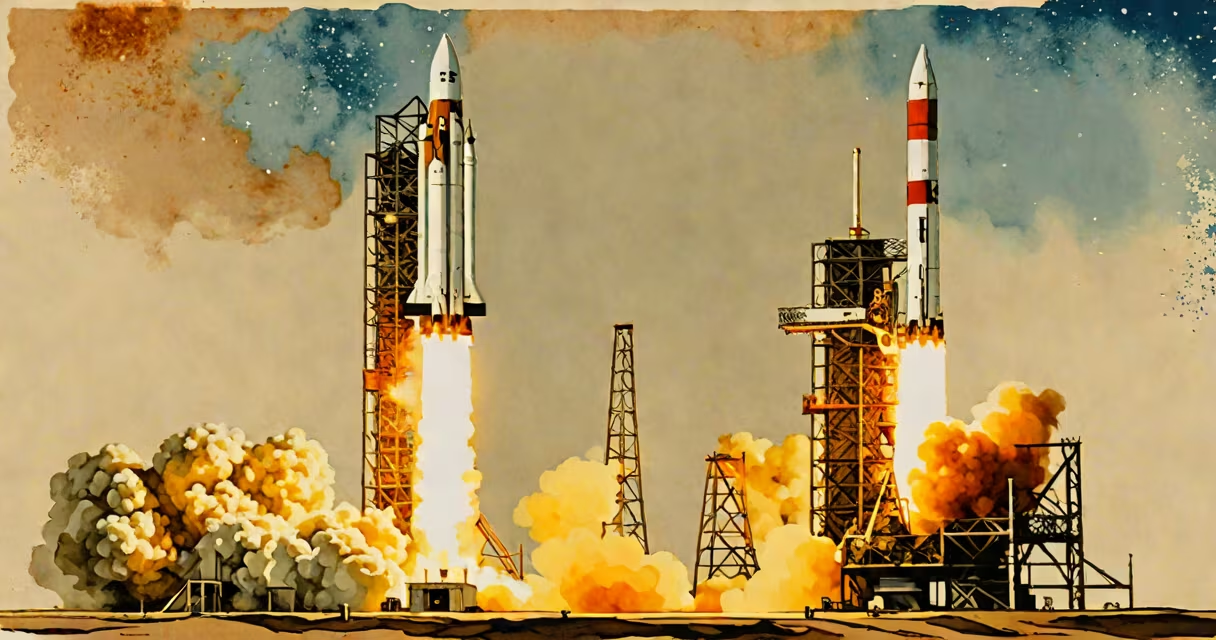
Space exploration began as a Cold War competition between the U.S. and Soviet Union, evolving into a pursuit of scientific discovery and technological advancement. The space race, sparked by geopolitical tensions, drove rapid progress in rocket technology and orbital achievements.
The primary cause of early space exploration was the Cold War rivalry between the United States and the Soviet Union. After World War II, both nations sought to demonstrate technological superiority. The Soviets launched Sputnik 1 in 1957, the first artificial satellite, triggering the space race. The U.S. responded with the creation of NASA in 1958 and the Apollo program, culminating in the 1969 moon landing.
Beyond political motivations, space exploration has always been driven by scientific curiosity. Studying celestial bodies provides insights into the universe's origins and Earth's place within it. For example, the Hubble Space Telescope has revealed the age of the universe and the existence of dark energy. Missions to Mars, such as those conducted by rovers like Curiosity, seek signs of past life and prepare for future human exploration.
| Type | Examples | Primary Goal |
|---|---|---|
| Orbital Missions | International Space Station (ISS) | Long-term research in microgravity |
| Lunar Missions | Apollo 11, Artemis program | Moon landings and sample returns |
| Planetary Missions | Voyager, Cassini | Study of planets and their moons |
| Deep Space Missions | New Horizons, James Webb Telescope | Exploration beyond our solar system |
Space exploration has led to numerous technological advancements that benefit everyday life. Satellite technology, developed for space missions, now supports global communications, weather forecasting, and GPS navigation. Medical research in space has improved treatments for osteoporosis and muscle atrophy. The development of lightweight materials and efficient energy systems for spacecraft has also led to innovations in consumer products and industrial applications.
Many people believe that space exploration is solely driven by the search for extraterrestrial life. While this is a significant goal, it is not the primary motivation. The initial drive came from political competition, followed by scientific research and technological innovation. Another misconception is that space exploration is too expensive. However, the long-term benefits, including technological advancements and scientific discoveries, often outweigh the costs.
As a former intern at NASA's Jet Propulsion Laboratory, I witnessed firsthand how space missions require collaboration among scientists, engineers, and policymakers. The integration of diverse expertise helps each mission addresses multiple goals, from scientific research to technological demonstration.