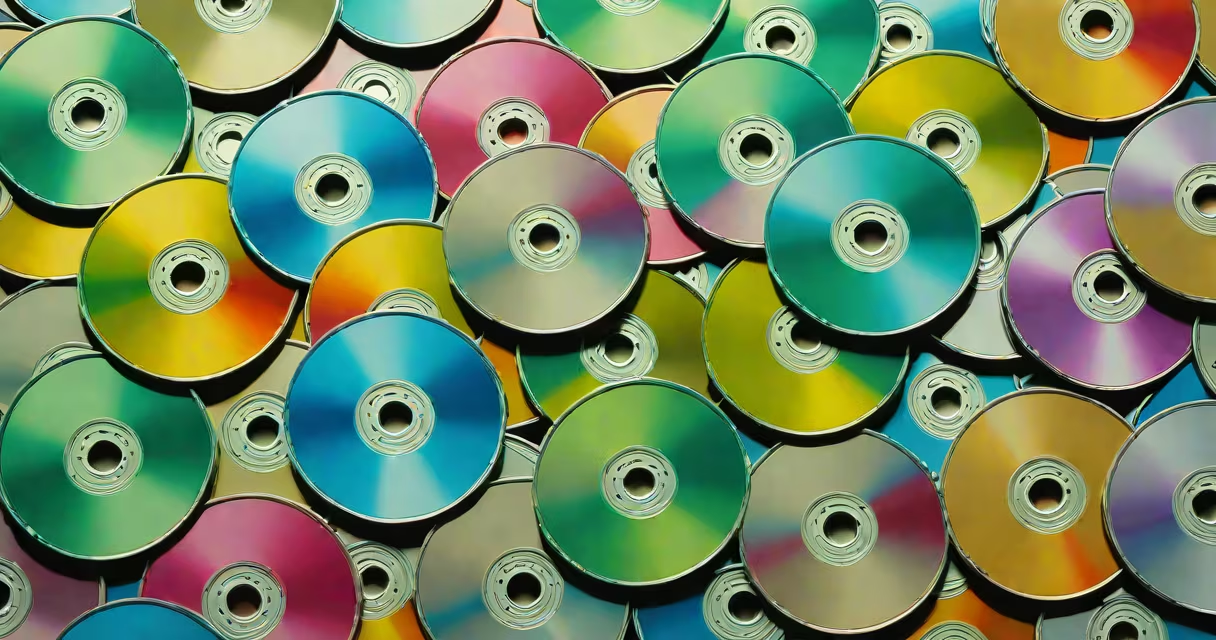
CD stands for "Compact Disc," a digital optical disc storage medium that uses tiny pits and lands to encode data. Originally developed for music, CDs later expanded to store software, videos, and other data.
A CD contains microscopic pits arranged in a spiral track. A laser reads these pits as binary data (0s and 1s). The reflective areas between pits are called "lands." This physical encoding allows CDs to store up to 700 MB of data.
| Type | Description | Capacity |
|---|---|---|
| CD-DA | Standard audio CD | 74-80 minutes |
| CD-ROM | Read-only memory for software/data | 650-700 MB |
| CD-R | Recordable blank disc | 650-700 MB |
| CD-RW | Rewritable disc | 650-700 MB |
Before CDs, music was distributed on vinyl records or cassette tapes, which degraded over time. CDs offered superior sound quality, durability, and random access (skip to any track instantly). They became the standard for music distribution in the 1980s and 1990s.
Beyond music, CDs enabled software distribution. Early computer games and applications often came on multiple CDs due to their limited capacity compared to modern storage solutions.
Many assume CDs are obsolete, but they remain useful for archival purposes, audio mastering, and niche applications. Unlike flash drives, CDs don't rely on electricity to retain data, making them ideal for long-term storage.
Another misconception is that CDs are slow. While early CD-ROM drives had data transfer rates of 150 KB/s, later versions reached 52x speed (about 7.8 MB/s), comparable to early USB flash drives.
Unlike cloud storage, CDs provide physical control over data. This makes them valuable for sensitive information where internet exposure is a concern.
I once helped digitize a small record label's archive. While most files were on modern drives, critical master recordings were stored on CDs. The CDs, kept in a climate-controlled environment, played flawlessly after 20 years-proof of their longevity.
The CD full form reflects its original purpose, but its impact extends far beyond music. CDs revolutionized data storage, offered durability, and remain relevant in specific applications today.