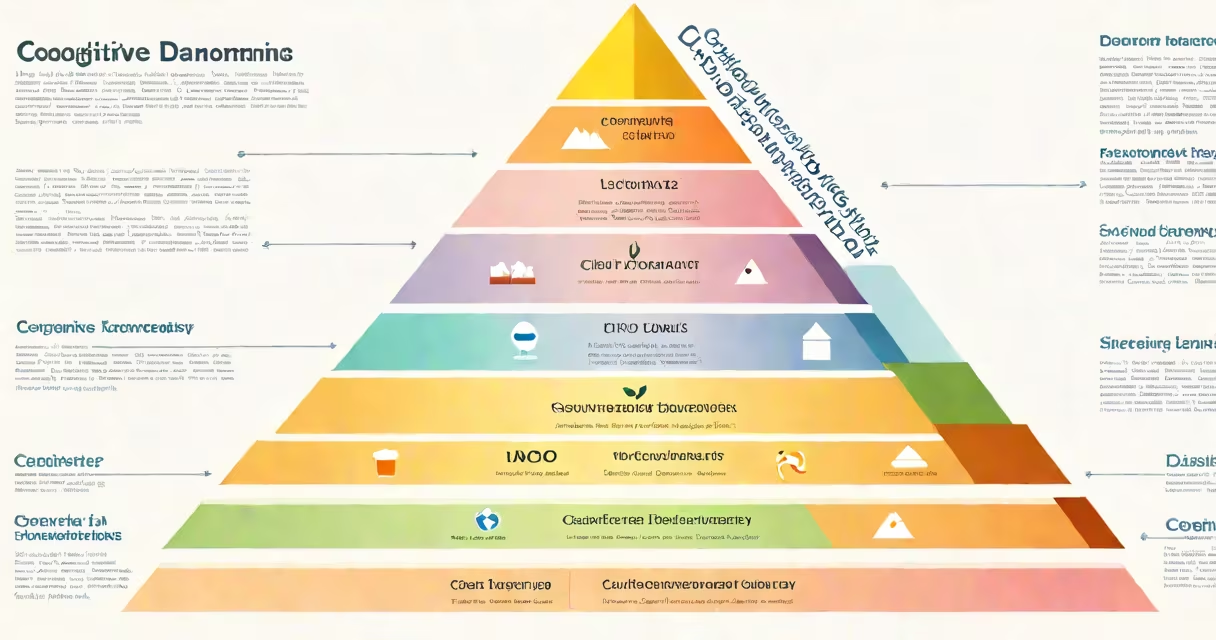
The cognitive domain refers to the mental skills and knowledge students acquire through learning, as defined by Bloom's taxonomy. It includes six hierarchical levels of thinking, from basic recall to complex evaluation.
Bloom's taxonomy, developed by Benjamin Bloom in 1956, categorizes educational goals into three domains: cognitive, affective, and psychomotor. The cognitive domain focuses solely on intellectual abilities, such as remembering facts, applying concepts, and analyzing information.
The cognitive domain is structured as a pyramid, with each level building on the previous one. Lower levels involve simpler tasks, while higher levels require deeper understanding and critical thinking. For example, a student might first memorize historical dates (remembering) before comparing different historical events (evaluating).
Each level of the cognitive domain has specific actions associated with it. For instance, "identifying" falls under remembering, while "summarizing" belongs to understanding. Teachers use these action verbs to create measurable learning objectives for their students.
| Level | Key Action Verbs | Example Learning Objective |
|---|---|---|
| Remembering | List, define, recall | A student can list the major causes of World War I. |
| Understanding | Explain, summarize, interpret | A student can explain the plot of a novel in their own words. |
| Applying | Use, solve, implement | A student can solve a math problem using the quadratic formula. |
| Analyzing | Compare, contrast, differentiate | A student can compare and contrast two scientific theories. |
| Evaluating | Critique, justify, defend | A student can critique the effectiveness of a marketing campaign. |
| Creating | Design, construct, develop | A student can design a sustainable city plan. |
Teachers use the cognitive domain to set clear, measurable learning objectives for their students. By structuring lessons around Bloom's taxonomy, educators ensure that students progress from basic knowledge to advanced critical thinking. For example, a biology teacher might start with remembering key terms before moving on to analyzing experimental results.
The cognitive domain is also used in standardized testing to assess students' understanding of material. Tests often include questions at different levels of the cognitive domain, from multiple-choice questions (remembering) to essay prompts (evaluating).
Many people confuse the cognitive domain with the affective and psychomotor domains. While the cognitive domain focuses on intellectual skills, the affective domain deals with emotions and attitudes, and the psychomotor domain involves physical skills. For instance, learning to play a musical instrument primarily engages the psychomotor domain, not the cognitive domain.
Another misconception is that higher levels of the cognitive domain are always better. While higher levels require more complex thinking, lower levels like remembering are still essential. For example, a doctor must remember medical facts before they can diagnose a patient (applying).
I once observed a classroom where the teacher used Bloom's taxonomy to structure a lesson on climate change. Students started by recalling basic facts about greenhouse gases (remembering), then moved on to analyzing data from different studies (analyzing), and finally created their own proposals for reducing emissions (creating). This approach ensured that all students, regardless of their initial knowledge level, could engage with the material.
The cognitive domain meaning, as defined by Bloom's taxonomy, provides a structure for structuring learning objectives and assessing student understanding. By progressing through the six levels--students develop a deeper and more complete understanding of the material. Understanding the cognitive domain helps educators design effective lessons and tests that promote critical thinking and knowledge retention.