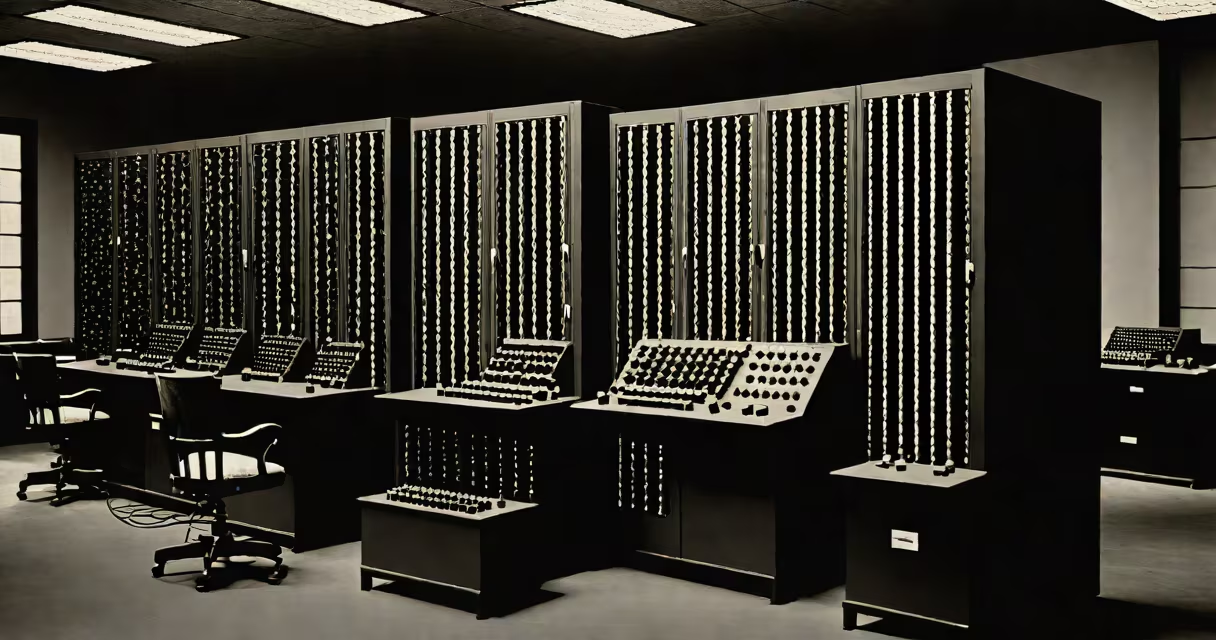
The first computer ever was ENIAC, a 30-ton machine built in 1945 that used 18,000 vacuum tubes to perform calculations. Unlike modern computers, ENIAC wasn't programmable in the way we understand today-it had to be physically rewired to switch between tasks.
ENIAC (Electronic Numerical Integrator and Computer) processed decimal numbers directly, unlike binary systems used today. It could perform about 5,000 additions per second, a notable speed for its time. However, reprogramming it took weeks because technicians had to manually reroute wires and set switches.
ENIAC consisted of:
Developed at the University of Pennsylvania, ENIAC was initially designed to calculate artillery firing tables for the U.S. Army during World War II. After the war, it was used for scientific calculations, including early work on the hydrogen bomb.
ENIAC marked a shift from mechanical calculators to electronic computing. Before ENIAC, computers were human-teams of mathematicians performed calculations by hand. ENIAC automated this process, though it still required extensive human intervention.
Many assume ENIAC was the first electronic computer, but that title goes to the Atanasoff-Berry Computer (ABC), created in 1942. ABC was smaller and used binary digits, but it wasn't programmable. ENIAC was more versatile, earning it the "first general-purpose computer" label.
ENIAC's programmers, six women including Betty Holberton and Kay McNulty, played important roles in its operation. Their work laid groundwork for modern programming languages. The team developed techniques still used today, like subroutines and debugging.
ENIAC's success proved electronic computers were viable, paving the way for smaller, faster machines. By the 1950s, transistor-based computers replaced vacuum tube models. Today, ENIAC is displayed at the Smithsonian National Museum of American History.
While ENIAC wasn't the first electronic computer, it was the first truly influential one. Its design inspired later machines, and its legacy lives on in every computer built since. For a glimpse into early computing humor, check out the first joke ever about computers from this era.