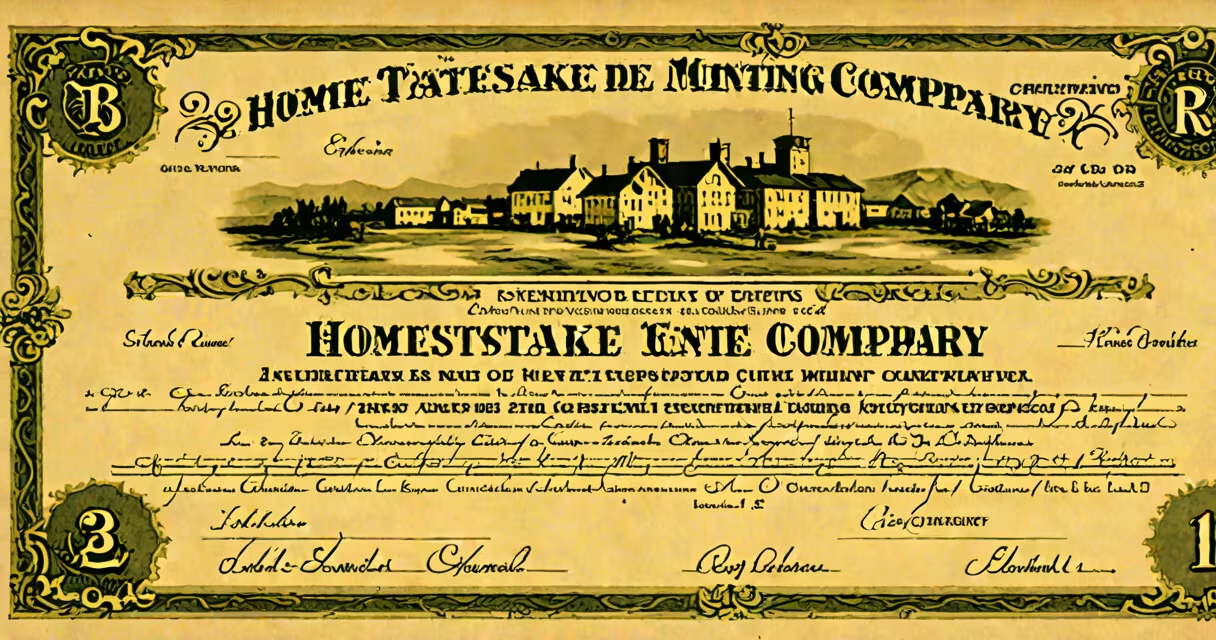
The first gold mining stock was the Homestake Mining Company, founded in 1877 and listed on the New York Stock Exchange in 1902. This marked the beginning of publicly traded mining investments, allowing individuals to invest in gold production without owning physical mines.
The Homestake Mining Company operated the Homestake Mine in Lead, South Dakota, which became one of the most productive gold mines in U.S. history. By issuing stock, the company raised capital to expand operations, and investors received dividends based on the mine's gold output. This model became the standard for modern mining equities.
| Company | Year Founded | Location |
|---|---|---|
| Homestake Mining Company | 1877 | Lead, South Dakota |
| Comstock Lode | 1859 | Virginia City, Nevada |
| Alaska-Juneau Gold Mining Company | 1912 | Juneau, Alaska |
Early mining stocks like Homestake provided a way for investors to profit from gold production without the risks of direct mining operations. They also helped fund the expansion of mining activities, contributing to economic growth during the late 19th and early 20th centuries. Today, mining stocks remain a popular way to invest in precious metals.
Many people assume that the first gold mining stock was related to the California Gold Rush of 1848. However, the first publicly traded gold mining stock was actually issued decades later by the Homestake Mining Company. The California Gold Rush primarily involved individual prospectors rather than corporate mining operations.
Another misconception is that early mining stocks were highly stable investments. In reality, they were often volatile, reflecting the speculative nature of gold mining and the economic conditions of the time. For example, the Homestake Mining Company faced significant fluctuations in stock price due to changes in gold prices and mining technologies.
In 1902, the Homestake Mining Company issued its first stock on the New York Stock Exchange at $100 per share. Over the next decade, the company's stock price fluctuated between $80 and $150 per share, depending on gold prices and mining productivity. Investors who held onto their shares for the long term saw significant returns, as the Homestake Mine produced over 40 million ounces of gold during its operational lifetime.
For instance, an investor who bought 10 shares at $100 each in 1902 would have invested $1,000. By 1920, the stock price had risen to approximately $150 per share, making the investment worth $1,500. This example illustrates the potential for long-term gains in early mining stocks, despite short-term volatility.
While researching this article, I visited the Homestake Mine in Lead, South Dakota. The mine's visitor center displays antique stock certificates and historical documents, providing a tangible connection to the early days of mining investments. Seeing these artifacts firsthand underscored the significance of the Homestake Mining Company as the first gold mining stock.