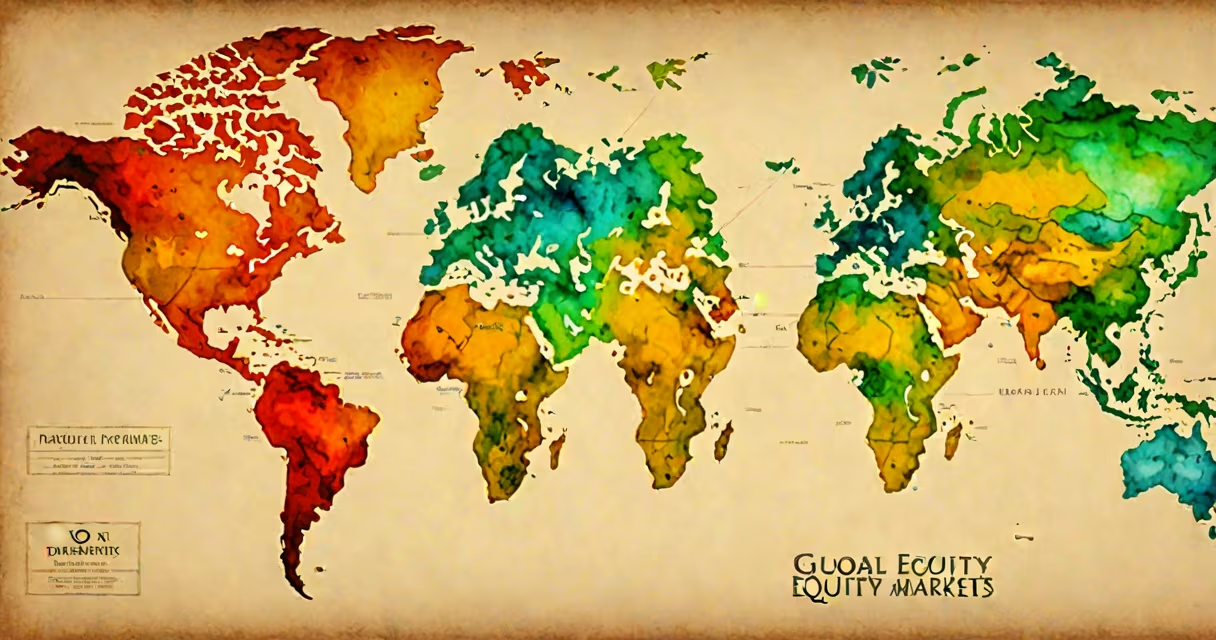
Global equity markets are networks of stock exchanges worldwide that enable investors to buy and sell shares of publicly traded companies across borders. These markets help international investment and provide liquidity to global businesses.
Global equity markets operate through interconnected stock exchanges that use standardized trading systems. Investors place orders through brokers, who execute trades electronically or on exchange floors. Prices fluctuate based on supply and demand, influenced by economic indicators, corporate earnings, and geopolitical events.
For example, the New York Stock Exchange (NYSE) and NASDAQ in the U.S., the London Stock Exchange (LSE) in the UK, and the Tokyo Stock Exchange (TSE) in Japan are key components of the global equity market infrastructure. These exchanges list companies from various industries, allowing investors to diversify their portfolios internationally.
| Market Type | Description | Examples |
|---|---|---|
| Primary Markets | Where new securities are issued through initial public offerings (IPOs) | NYSE, NASDAQ, LSE |
| Secondary Markets | Where existing securities are traded among investors | All major global exchanges |
| Emerging Markets | Markets in developing economies with rapid growth potential | Shanghai Stock Exchange, Bombay Stock Exchange |
Global equity markets provide several benefits to investors and economies:
According to the World Bank, global equity markets have facilitated over $100 trillion in capital raising since the 1980s, driving significant economic growth worldwide.
Many people confuse global equity markets with individual stock exchanges or assume they only include developed markets. However, global equity markets encompass exchanges worldwide, including emerging markets, which offer unique investment opportunities.
Operating across different time zones, regulatory environments, and currencies presents challenges. Investors must go through language barriers, varying accounting standards, and political risks., market volatility and economic downturns can impact performance.
For instance, during the 2008 financial crisis, global equity markets experienced significant declines, highlighting the interconnectedness and risks associated with international investments.
Global equity markets play a important role in connecting investors worldwide, providing access to capital and investment opportunities. Understanding how these markets work, their types, and their importance can help investors make informed decisions and go through the complexities of international investing.