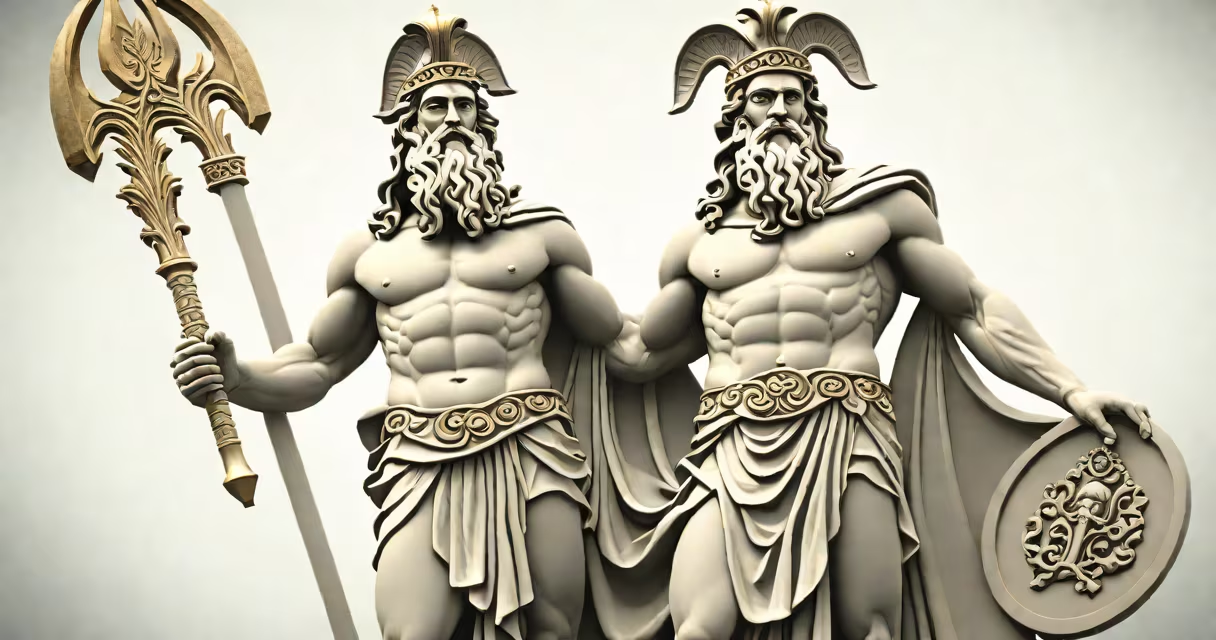
The Greek god of the sea is Poseidon, ruler of the oceans who wields a trident to stir storms and earthquakes. He is one of the Twelve Olympians, brother to Zeus and Hades.
Poseidon commands winds, waves, and sea creatures. Sailors prayed to him for safe voyages. His temper caused shipwrecks, but he also calmed seas for those he favored. Homer's Odyssey depicts his wrath against Odysseus, delaying the hero's return home for ten years.
While Poseidon is the primary god of the sea, other figures share domain:
| Deity | Role | Symbols |
|---|---|---|
| Poseidon | God of the sea, earthquakes, and horses | Trident, dolphin, horse |
| Amphitrite | Sea queen, Poseidon's wife | Seashell, fish tail |
| Proteus | Shape-shifting sea god | Seals, changing forms |
Ancient Greeks built temples to Poseidon along coastlines and islands. Athens held an annual festival, the Poseidonia, with chariot races. Sailors carved tridents into ship prows for protection. Poseidon's cult was strongest in Corinth, where he shared a temple with Athena.
Unlike Zeus, who ruled the sky, Poseidon's domain was the unpredictable sea. The Greeks saw the ocean as both a highway and a threat, reflecting their reliance on maritime trade. Poseidon's dual nature-generous and destructive-mirrored their relationship with the water.
Many confuse Poseidon with Neptune, the Roman equivalent, but their myths differ. Neptune lacked Poseidon's connection to horses, for example. Another mistake is calling Poseidon the god of all water; freshwater rivers belonged to Oceanus or local nymphs.
I once visited the Temple of Poseidon at Sounion. Standing on the cliffs at sunset, I understood why sailors feared his wrath-the Aegean stretched endlessly, its waves crashing below like thunder.
Poseidon's influence persists in modern culture. The trident symbol appears in naval insignia worldwide. The 2006 film Poseidon reimagined his power in a disaster scenario. Even the planet Neptune bears his Roman name, showing his enduring legacy.