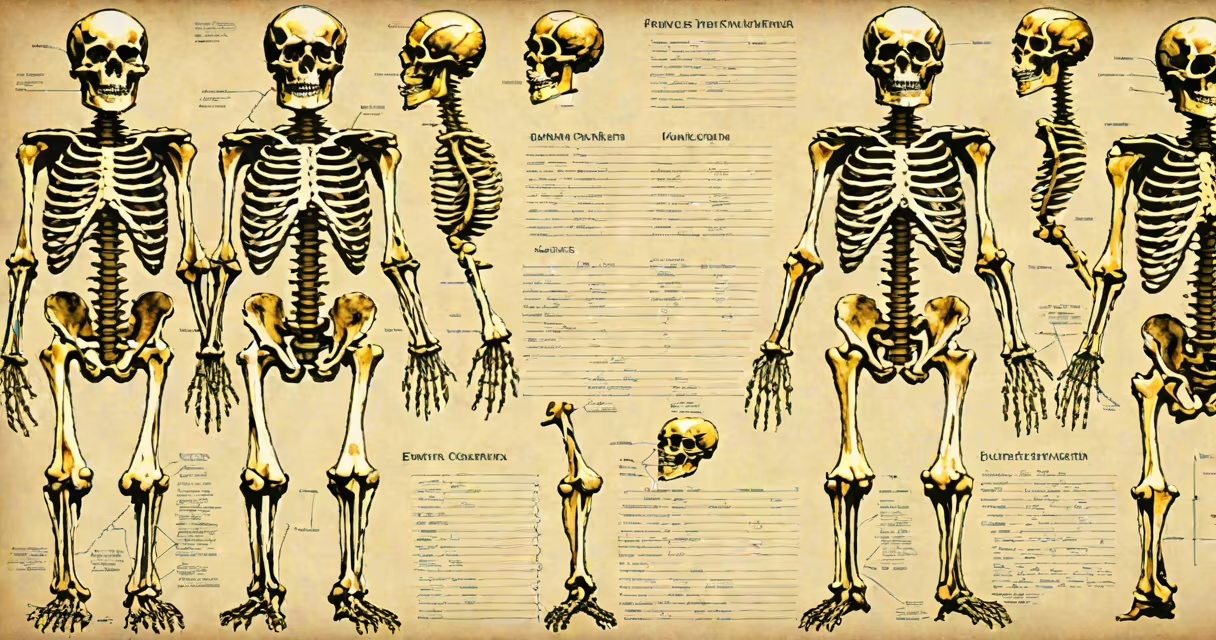
Images of bones in human body show the 206-piece structure of interconnected parts that support movement, protect organs, and produce blood cells. These images typically come from medical textbooks, anatomical models, or diagnostic scans.
The human skeleton serves five key functions: support, movement, protection, blood cell production, and mineral storage. Bones connect at joints, allowing movement through muscle contraction. The skull protects the brain, the ribs shield the heart and lungs, and the spine safeguards the spinal cord.
The human body contains four primary bone types, each with distinct shapes and functions:
| Type | Shape | Examples |
|---|---|---|
| Long bones | Longer than wide | Femur, tibia, humerus |
| Short bones | Cube-like | Wrist and ankle bones |
| Flat bones | Thin and flat | Skull, sternum, ribs |
| Irregular bones | Various complex shapes | Vertebrae, hip bones |
Medical professionals use images of bones to diagnose fractures, infections, or diseases like osteoporosis. Students learn anatomy through labeled diagrams. Researchers study bone development and healing processes. A common misconception is that all bones are hard and rigid - some, like those in infants, contain more flexible cartilage.
Consider the femur, the longest bone in the body. In images, you'll see its cylindrical shaft and rounded ends. The head fits into the hip socket, while the lower end connects to the knee joint. A fracture here often appears as a clear break in medical scans. Understanding such details helps doctors set bones properly after injuries.
When I studied anatomy, I used a detailed skeletal model to visualize how bones connect. Seeing the actual structure helped me understand how movements like walking involve multiple bones working together. This hands-on approach made the theoretical information much clearer.