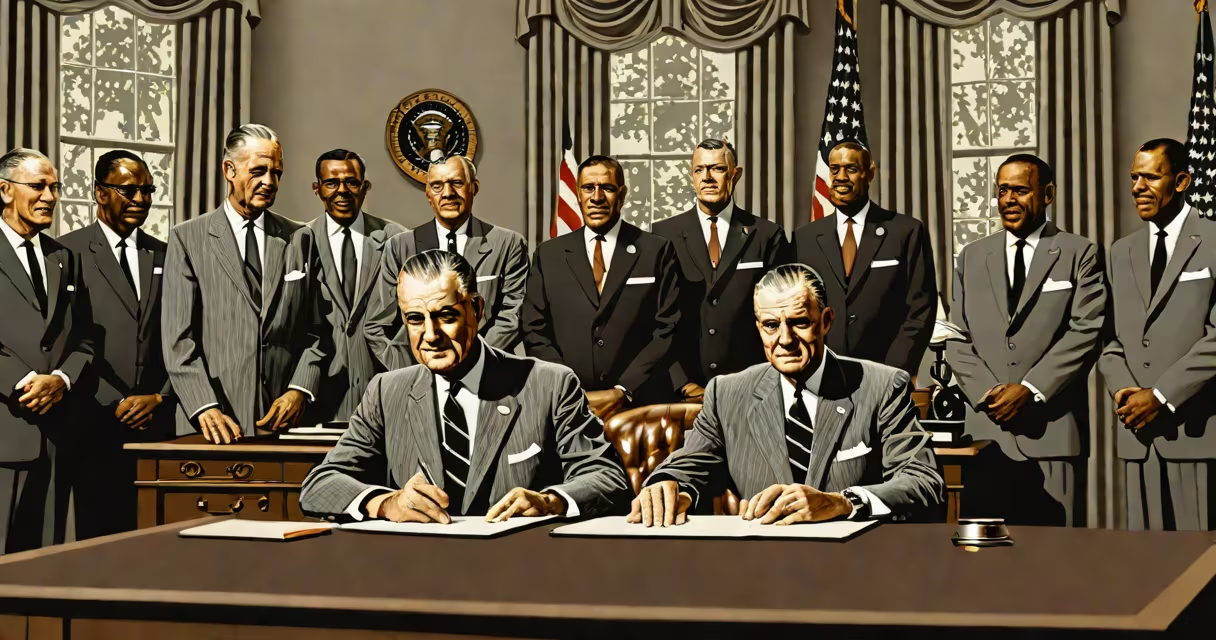
Important civil rights legislation refers to federal laws passed primarily between 1964 and 1968 that prohibited discrimination based on race, color, religion, sex, or national origin. These laws established legal protections for voting rights, fair housing, and equal access to public accommodations.
These laws created enforcement mechanisms through federal agencies like the Department of Justice and Equal Employment Opportunity Commission. They authorized lawsuits against discriminatory practices and required government agencies to collect data on compliance. The laws also provided funding for programs to address systemic inequalities.
Before these laws, racial segregation was legal in many parts of the U.S. The legislation transformed American society by:
According to the U.S. Commission on Civil Rights, these laws reduced racial disparities in education, employment, and housing access during the 1970s. However, enforcement challenges and loopholes have required additional legislation and court rulings to address ongoing discrimination.
Many people confuse civil rights legislation with:
A common misunderstanding is that these laws completely eliminated discrimination. In reality, they created legal tools to challenge discriminatory practices, which required ongoing enforcement efforts.
One clear example of impact occurred in 1966 when the U.S. Department of Health, Education, and Welfare issued guidelines implementing Title VI of the Civil Rights Act. These guidelines cut off federal funding to school districts that maintained segregated schools, leading to desegregation efforts across the South.
While working with community organizations in the 1990s, I saw how these laws still influenced local policies. The Fair Housing Act, for example, helped communities challenge discriminatory zoning practices that maintained racially segregated neighborhoods.
For more details about specific laws and their implementation, explore federal civil rights protections.