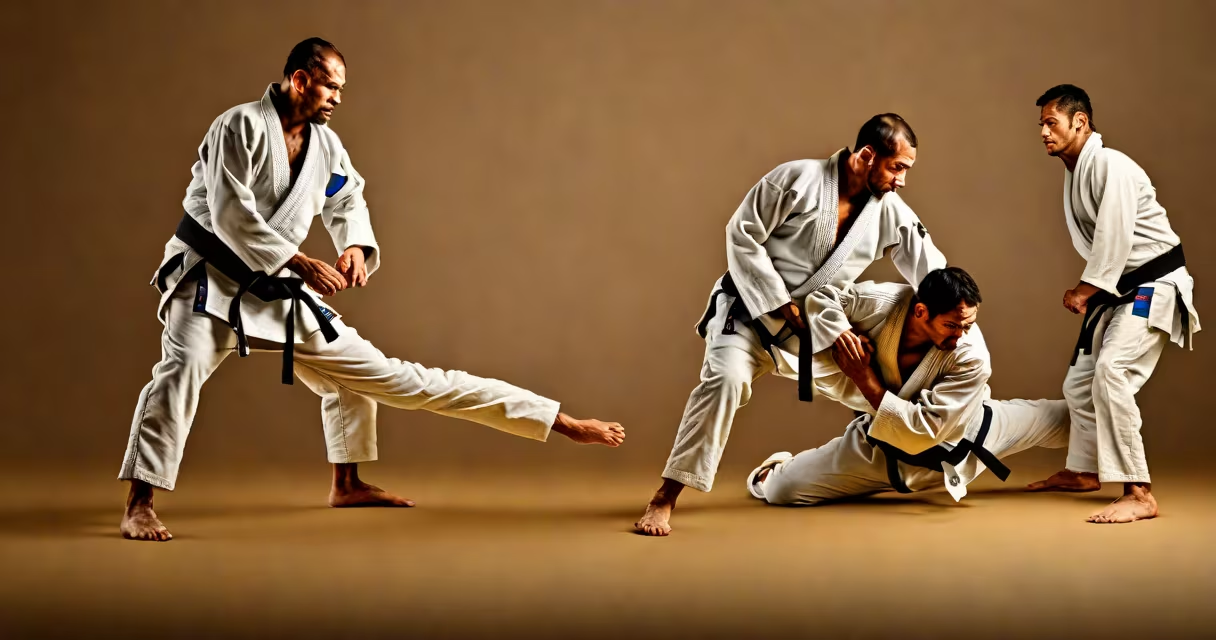
Judo and jiu jitsu are distinct martial arts that share common origins but emphasize different techniques and philosophies. Judo focuses on throws and takedowns, while jiu jitsu includes ground fighting and submissions.
Both martial arts trace their roots to Japan. Jiu jitsu, or jujutsu, dates back to the 17th century as a combat system for samurai. Judo emerged in the late 19th century as a derivative of jiu jitsu, founded by Professor Jigoro Kano. Kano sought to create a modern martial art that emphasized self-improvement and physical education.
The primary differences between judo and jiu jitsu lie in their techniques and objectives. Judo emphasizes throws (nage-waza) and pins (katame-waza), while jiu jitsu includes joint locks (kansetsu-waza) and chokeholds (shime-waza).
| Aspect | Judo | Jiu Jitsu |
|---|---|---|
| Founding | Late 19th century | 17th century |
| Focus | Throws and pins | Ground fighting and submissions |
| Competition | Olympic sport | Brazilian jiu-jitsu tournaments |
Many people confuse judo and jiu jitsu due to their shared history. However, judo is primarily a standing martial art, while jiu jitsu incorporates extensive groundwork., judo is an Olympic sport, whereas jiu jitsu is popularized through Brazilian jiu-jitsu (BJJ) competitions.
Both martial arts are effective for self-defense and physical fitness. Judo's throws can neutralize an attacker quickly, while jiu jitsu's ground techniques are useful for controlling an opponent in close quarters. Many law enforcement agencies train in these arts for their practical applications.
I have trained in both judo and jiu jitsu and found that judo's throws are more straightforward for self-defense scenarios, while jiu jitsu's ground game provides a deeper understanding of use and control.
Judo and jiu jitsu are distinct martial arts with unique techniques and philosophies. Understanding their differences can help practitioners choose the style that best fits their goals, whether for competition, self-defense, or personal development.