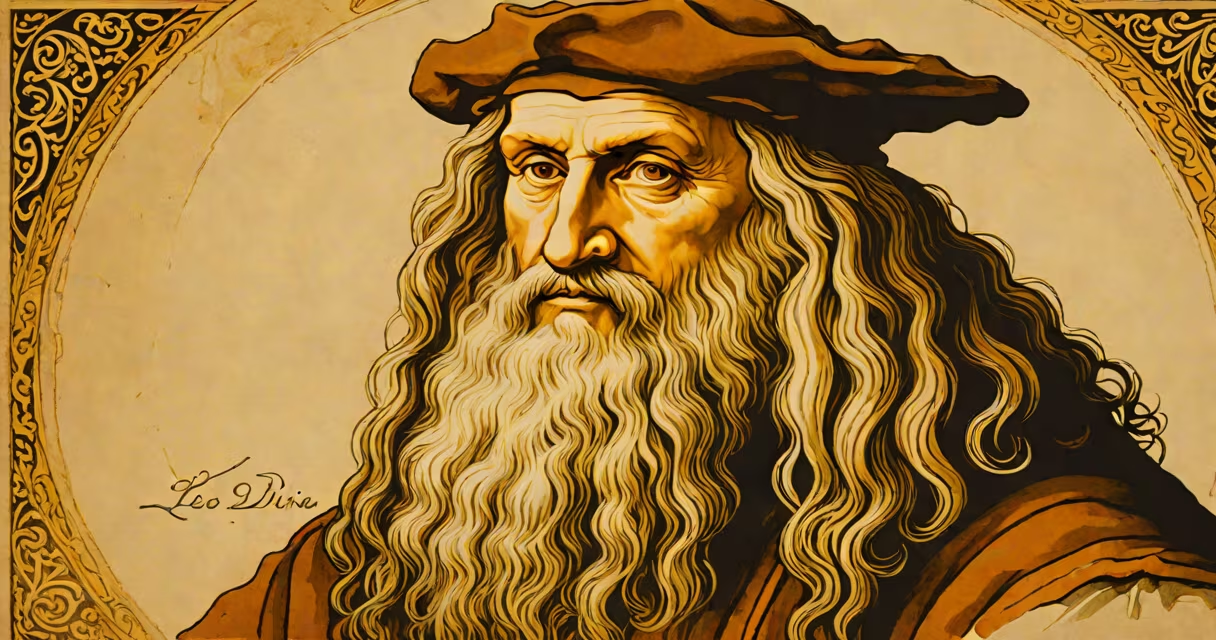
Leonardo da Vinci (1452-1519) was an Italian polymath of the Renaissance whose work spanned painting, sculpture, architecture, science, music, mathematics, engineering, literature, anatomy, geology, astronomy, botany, writing, history, and cartography. He is widely regarded as one of the greatest painters of all time and perhaps the most diversely talented person ever to have lived.
Born on April 15, 1452, in the Tuscan hill town of Vinci, Leonardo was the illegitimate son of a Florentine notary and a peasant woman. His early education was limited, but he showed an early aptitude for art. At age 14, he became an apprentice to Andrea del Verrocchio, a prominent Florentine painter and sculptor. This apprenticeship lasted until his mid-20s and provided him with a solid foundation in the arts and sciences of the time.
Da Vinci's most famous works include the Mona Lisa and The Last Supper, both of which are renowned for their new techniques and enduring mystery. The Mona Lisa, painted between 1503 and 1506, is celebrated for its sfumato technique, which blends colors and tones to model forms without clear outlines. The Last Supper, painted between 1495 and 1498, is known for its dramatic use of perspective and the emotional intensity of the figures.
Beyond painting, da Vinci made significant contributions to various fields. His notebooks, filled with detailed sketches and scientific observations, reveal his interest in human anatomy, flight, and engineering. For example, his designs for flying machines and war devices were centuries ahead of their time. He also studied the flow of water, the structure of the heart, and the mechanics of the human body.
Da Vinci's scientific inquiries were new. He dissected cadavers to understand human anatomy, creating detailed drawings of muscles, tendons, and internal organs. His anatomical studies influenced medical science for centuries., his designs for machines, such as the helicopter-like ornithopter and the self-propelled cart, demonstrated an understanding of principles that would not be fully realized until the modern era.
His work on hydraulics and civil engineering included designs for canals, dams, and bridges. He also explored the principles of optics and light, contributing to the development of perspective in art. Da Vinci's interdisciplinary approach combined art and science, making him a pioneer in both fields.
Da Vinci's legacy endures through his art, scientific discoveries, and inventive spirit. His works continue to inspire artists, scientists, and engineers worldwide. The Mona Lisa and The Last Supper remain iconic symbols of the Renaissance, while his scientific and engineering notebooks provide valuable insights into the mind of a genius.
In recent years, da Vinci's influence has been recognized in popular culture and academia. Exhibitions, documentaries, and even fictional portrayals, such as in Dan Brown's per sempre si sal da vinci, have kept his legacy alive. His life and work serve as proof of the power of curiosity, creativity, and the pursuit of knowledge.
Da Vinci's impact on the world is immeasurable. His ability to integrate art and science set a standard for interdisciplinary study that continues to inspire generations. As a symbol of the Renaissance, he represents the pinnacle of human achievement and the endless possibilities of the human mind.