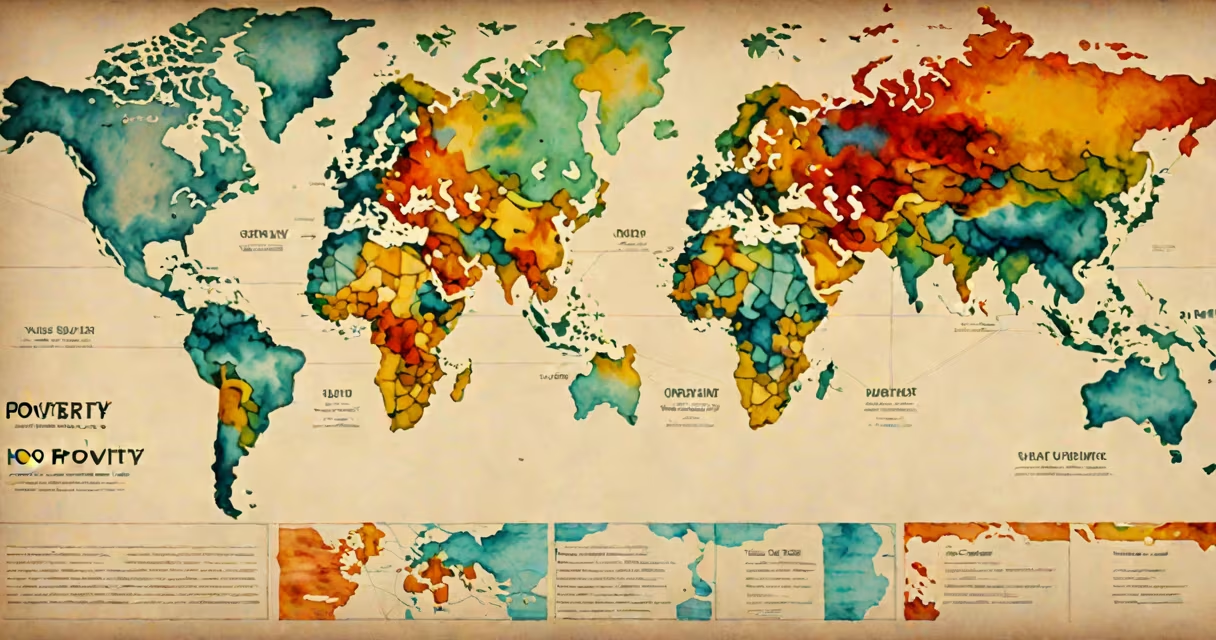
The no poverty meaning refers to the United Nations' Sustainable Development Goal (SDG) 1, which seeks to end extreme poverty worldwide by 2030. This goal targets populations living on less than $1.90 per day, aiming to lift them out of extreme poverty through economic growth, social protection, and access to basic services.
SDG 1 focuses on two primary objectives: eradicating extreme poverty and reducing poverty. The UN defines extreme poverty as living on less than $1.90 per day, adjusted for purchasing power parity. To achieve this, the UN employs a multi-faceted approach:
Poverty manifests in various forms, each requiring distinct solutions. The World Bank classifies poverty into three main types:
| Type | Definition | Example |
|---|---|---|
| Extreme Poverty | Living on less than $1.90 per day | A family in rural Africa surviving on subsistence farming |
| Moderate Poverty | Living on $3.20 to $5.50 per day | A household in Southeast Asia with unreliable income sources |
| Relative Poverty | td>Living below the median income level of a specific countryA single parent in the U.S. struggling to afford rent and childcare |
The no poverty meaning is applied globally, with a focus on regions with the highest poverty rates, such as Sub-Saharan Africa, South Asia, and parts of Latin America. The UN and other international organizations use this structure to allocate resources, measure progress, and hold governments accountable for reducing poverty.
One common misconception is that poverty is solely about lack of income. However, poverty is multidimensional, encompassing factors like access to education, healthcare, and political representation. For example, a person may have enough income but still face poverty due to limited access to quality education or healthcare.
Another mistake is assuming that poverty is an inevitable part of development. In reality, many countries have successfully reduced poverty through targeted interventions, such as China and India, which lifted hundreds of millions out of extreme poverty in recent decades.
Consider a village in rural Uganda where families live on less than $1.90 per day. The local government, with support from the UN, implements a program to provide microloans to women entrepreneurs. These loans enable women to start small businesses, such as selling produce or handmade crafts, increasing their household income., the program ensures access to primary education for children and basic healthcare for all villagers. Over time, these interventions lift the entire community out of extreme poverty, demonstrating the practical application of the no poverty meaning.
I witnessed a similar initiative during a trip to Bangladesh, where a nonprofit organization partnered with local farmers to introduce high-yield crops and better irrigation techniques. This collaboration provided farmers with a stable income, reducing their reliance on subsistence farming. Such grassroots efforts are important for achieving the UN's poverty eradication goals.