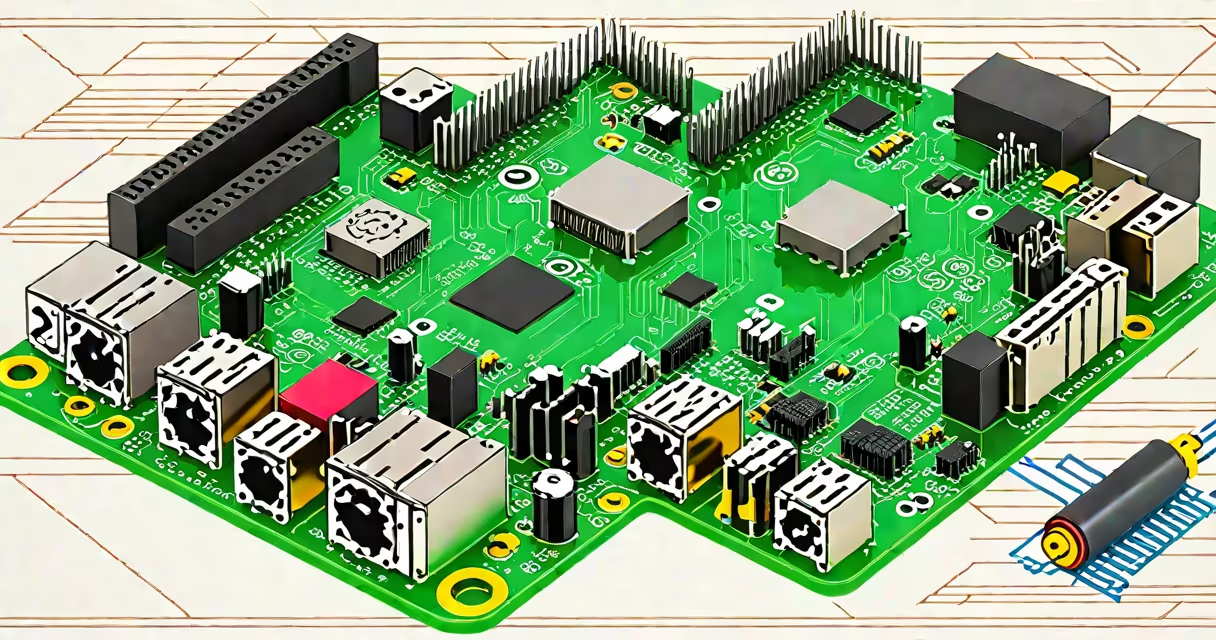
A raspberry pi ai accelerator is a hardware add-on that speeds up artificial intelligence tasks on Raspberry Pi devices by handling compute-intensive operations. These accelerators connect via USB or PCIe and work alongside the Pi's CPU to improve performance for machine learning, computer vision, and other AI applications.
AI accelerators contain specialized processors designed for matrix operations, which are common in machine learning algorithms. When a Raspberry Pi runs an AI application, the accelerator takes over specific tasks, freeing up the Pi's main processor for other operations. This division of labor improves processing speed and efficiency.
For example, the Intel Movidius Neural Compute Stick connects via USB and can process neural networks at up to 100 frames per second, far beyond what a Raspberry Pi can achieve alone.
| Type | Connection | Example Models | Key Features |
|---|---|---|---|
| USB-based | USB 3.0 | Intel Movidius Neural Compute Stick | Portable, plug-and-play, low power consumption |
| PCIe-based | PCI Express | NVIDIA Jetson Nano | Higher performance, more power-hungry |
| HAT (Hardware Attached on Top) | GPIO | Google Coral USB Accelerator | Dedicated AI coprocessor, optimized for TensorFlow Lite |
These accelerators are popular in edge computing applications where local processing is preferred over cloud-based solutions. Common uses include:
While traditional GPUs can also accelerate AI tasks, they are often too large and power-hungry for embedded systems. Raspberry Pi AI accelerators are designed specifically for low-power environments, making them ideal for IoT and edge computing applications., many accelerators come with software libraries optimized for common AI frameworks like TensorFlow and PyTorch.
One common misconception is that AI accelerators replace the need for a useful CPU. In reality, they complement the CPU by handling specific tasks, allowing the system to balance performance and power efficiency.
To begin using a Raspberry Pi AI accelerator, you'll need a compatible Raspberry Pi model, such as the Raspberry Pi 4 or 5, and the appropriate accelerator hardware. Many accelerators come with software development kits (SDKs) that simplify integration with existing projects.
For beginners, starting with a simple project like image classification using a pre-trained model can help you understand how the accelerator enhances performance. As you gain experience, you can explore more complex applications like real-time object detection or natural language processing.