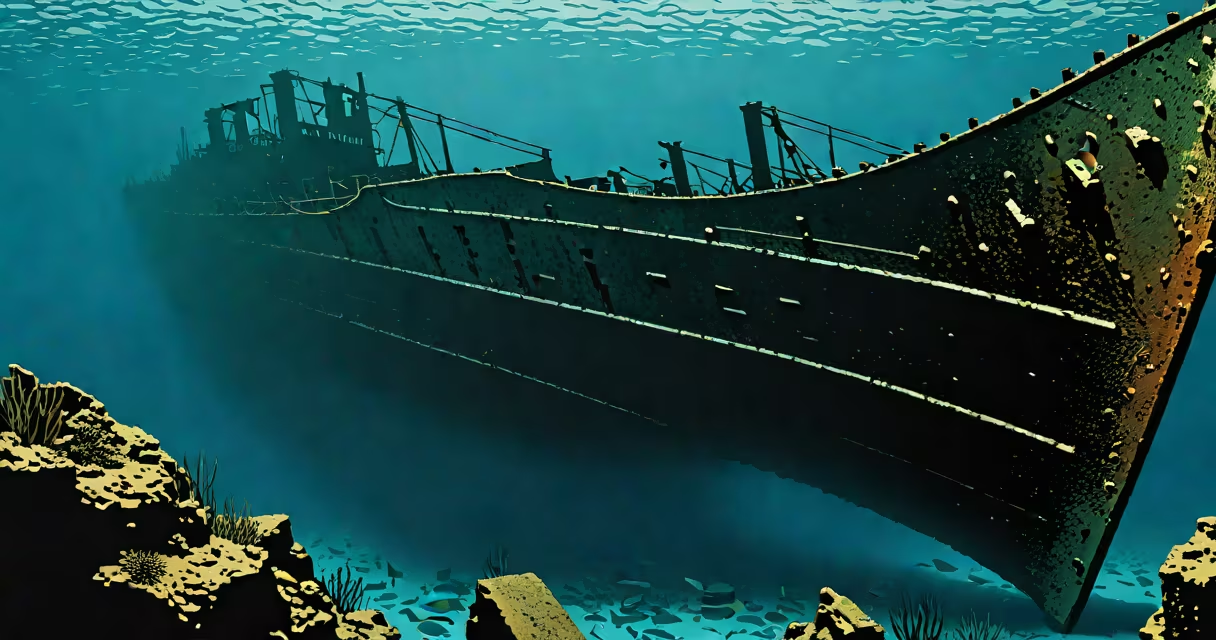
The RMS Titanic wreck is the sunken remains of the British ocean liner that struck an iceberg and sank in 1912, lying 370 miles southeast of Newfoundland at a depth of 12,500 feet.
On April 15, 1912, the Titanic sank after colliding with an iceberg during its maiden voyage York City. The disaster resulted in the deaths of more than 1,500 passengers and crew, making it one of the deadliest commercial peacetime maritime disasters in modern history.
The wreck was discovered on September 1, 1985, by a joint American-French expedition led by Robert Ballard. The discovery was made using an unmanned submersible called Argo, which captured the first images of the wreck. The Titanic was located about 370 miles southeast of Newfoundland, resting in two main pieces about 2,000 feet apart.
The wreck is situated in an area known as the Titanic graveyard, where other ships have also met their fate due to the treacherous conditions of the North Atlantic. The discovery provided valuable insights into the events of the sinking and has since been the subject of extensive exploration and study.
The Titanic wreck is slowly deteriorating due to the harsh underwater environment. The saltwater, bacteria, and deep-sea creatures are gradually breaking down the ship's structure. Experts estimate that the wreck may disappear entirely within the next few decades.
Despite its deteriorating condition, the wreck remains a significant historical site. Efforts have been made to preserve the remaining artifacts and document the wreck's condition through expeditions and underwater photography. The site is protected by international agreements, and removing artifacts is strictly regulated.
Since its discovery, numerous expeditions have visited the Titanic wreck, recovering thousands of artifacts. These items, ranging from personal belongings to structural components of the ship, provide a tangible connection to the disaster and offer insights into life aboard the Titanic.
Many of these artifacts are displayed in museums around the world, including the Titanic Belfast museum in Northern Ireland and the Titanic Museum in Las Vegas. The recovery and display of these items have sparked debates about the ethics of disturbing a grave site and the importance of preserving historical artifacts.
One common misconception is that the Titanic wreck is entirely intact. In reality, the ship broke into two main sections during the sinking, and both sections are severely damaged. The bow and stern are the most recognizable parts, but much of the ship has been destroyed by the impact and subsequent decay.
Another myth is that the wreck is easily accessible for diving. Due to its extreme depth and the dangerous conditions of the North Atlantic, visiting the wreck requires specialized equipment and expertise. Only a handful of expeditions have successfully explored the site, and recreational diving is not feasible.
For more detailed information about the Titanic, visit our complete guide on the Titanic.