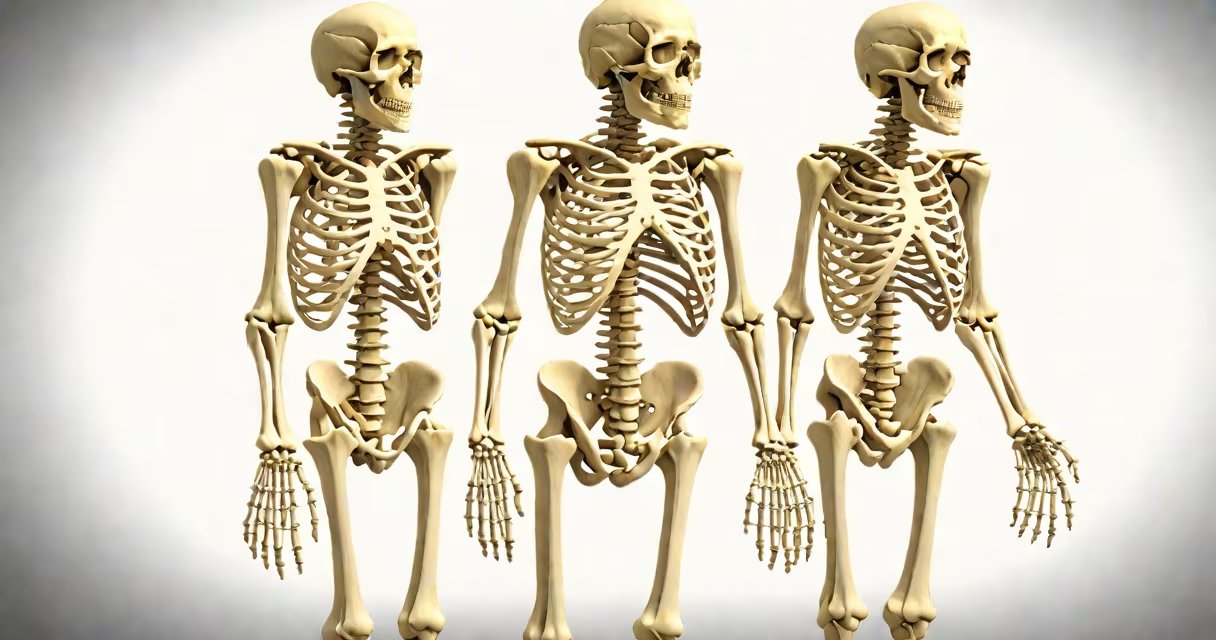
A skeletal system study examines the 206 bones that form your body's structure, their roles in movement, protection, and support, and how they develop and repair. This includes analyzing bone cells, structures, and the processes that maintain skeletal health.
The skeletal system serves as your body's internal scaffolding. Bones connect at joints, allowing movement through muscles. The system also produces blood cells, stores minerals, and protects important organs. Bones constantly remodel through a process called bone remodeling, where old bone is replaced by new bone.
Bone tissue consists of compact bone (dense outer layer) and spongy bone (porous inner layer). Osteoblasts build bone, while osteoclasts break it down. This balance maintains bone strength and structure.
The skeletal system contains five main types of bones:
| Type | Characteristics | Examples |
|---|---|---|
| Long bones | Longer than wide, with a shaft and two expanded ends | Femur, humerus |
| Short bones | Cube-shaped, nearly equal in length and width | Wrist and ankle bones |
| Flat bones | Thin, flattened, and often curved | Skull, ribs, sternum |
| Irregular bones | Complex shapes that don't fit other categories | Vertebrae, hip bones |
| Sesamoid bones | Small, round bones embedded in tendons | Patella (kneecap) |
For example, researchers study how astronauts' bones weaken in microgravity, leading to exercise regimens to prevent bone loss during space missions. This research benefits both space travelers and people with limited mobility on Earth.
Many believe bones are inert structures, but they're changing tissues that grow, repair, and adapt. Bones also store 99% of the body's calcium, releasing it when needed for muscle contractions and other functions.
Another myth is that bones stop growing after childhood. While long bones stop lengthening, bones continue growing in width throughout life. Osteocytes, mature bone cells, remain active, responding to mechanical stresses and hormonal signals.
I once created a quiz for students studying the skeletal system. Including images of bones from different angles helped them recognize structures in lab settings and clinical scenarios. The quiz also included questions about bone diseases, reinforcing the practical applications of skeletal system knowledge.