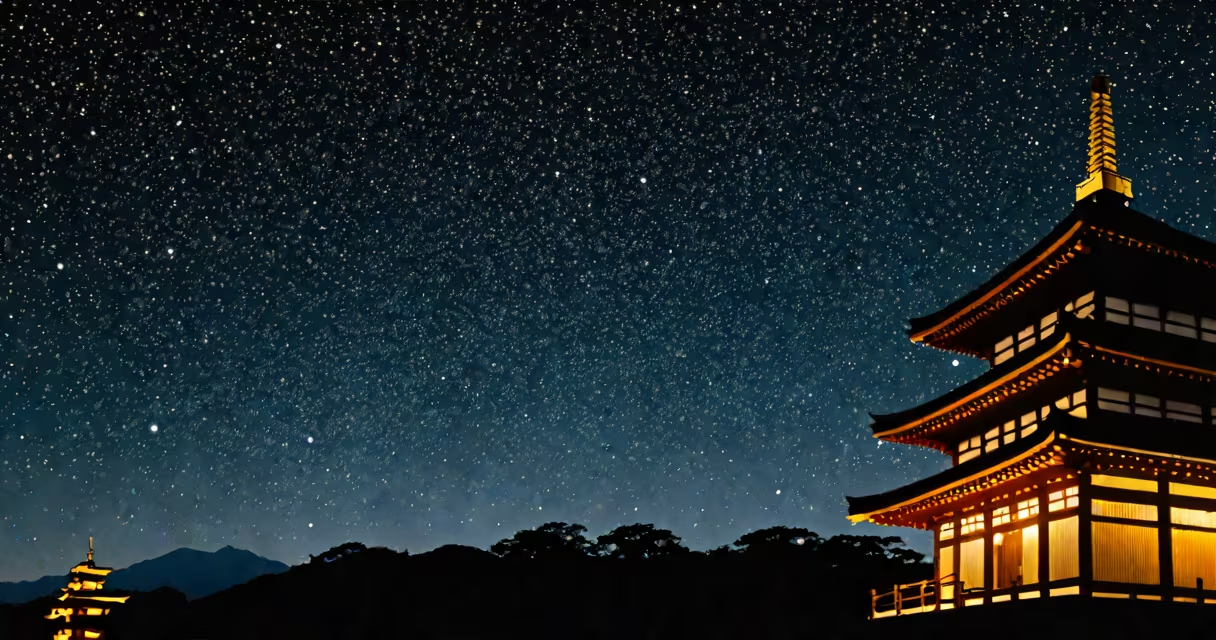
A star in Japanese is called "hoshi" (星). This kanji character represents celestial stars and has cultural significance beyond astronomy.
The term "hoshi" functions as both a noun and part of compound words. For example, "shooting star" translates to "ryūsei" (流星), combining "ryū" (flow) and "sei" (star). The Japanese language often uses "hoshi" metaphorically, such as "hoshi no kaze" (星の風), meaning "starlight breeze."
| Japanese Term | Romanization | Meaning |
|---|---|---|
| 星 | Hoshi | Star |
| 恒星 | Kōsei | Fixed star (like our Sun) |
| 惑星 | Wakusei | Planet (literally "wandering star") |
| 星座 | Seiza | Constellation |
"Hoshi" appears in Japanese poetry, folklore, and modern media. For instance, the famous haiku poet Matsuo Bashō used "hoshi" to symbolize hope and transience. In contemporary culture, "hoshi" features in anime titles like "Hoshizora e Kakaru Hashi" (A Bridge to the Starry Skies).
One non-obvious fact: the Japanese flag, known as the "hinomaru" (日の丸), includes a red circle representing the sun-a star. This design dates back to the 7th century.
People often confuse "hoshi" with "gisei" (犠牲), which means "sacrifice." While both terms use the kanji for star, their meanings differ entirely. Another mistake is assuming all Japanese star-related terms use "hoshi." For example, "kyokujitsu" (極星) means "Polaris," the North Star, and doesn't include "hoshi."
When I visited Kyoto, I noticed "hoshi" used in shop names and street signs, often symbolizing aspirations or dreams. A local artisan explained that stars represent guidance and good fortune in Japanese culture.
To translate the phrase "I wish upon a star" into Japanese, you'd say "Hoshi ni negai o." Breaking it down: "hoshi" (星) means "star," "ni" (に) is a particle indicating direction, "negai" (願い) means "wish," and "o" (を) is another particle marking the object of the action.