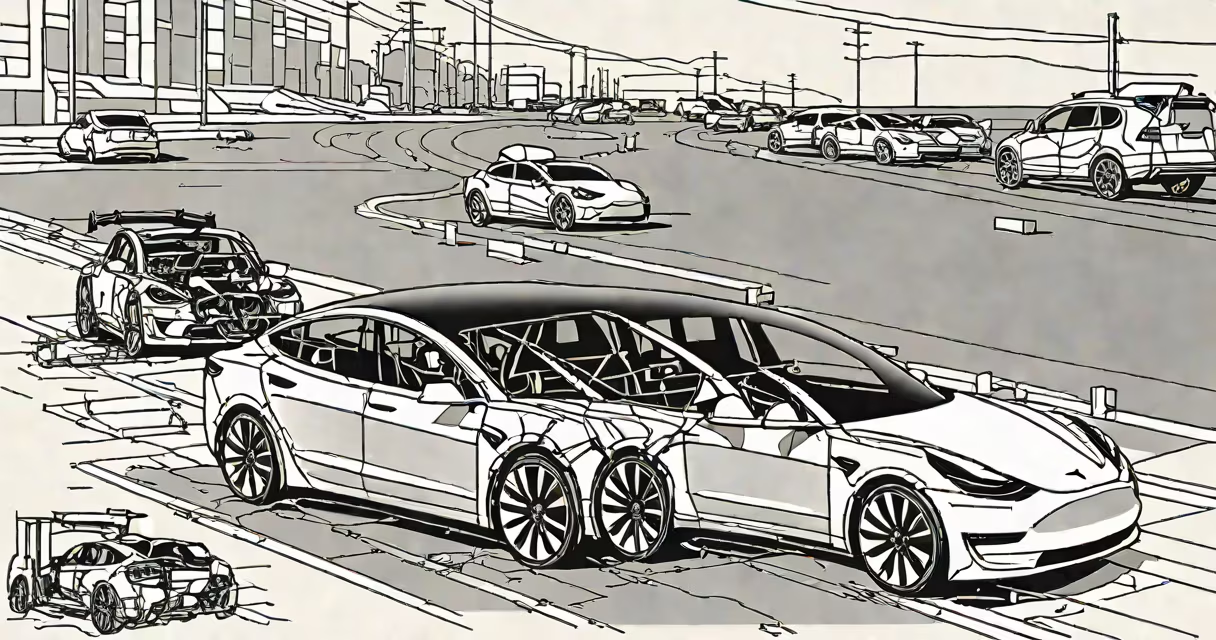
Tesla Autopilot AI is a neural network-based system enabling semi-autonomous driving features in Tesla vehicles, including lane centering, traffic-aware cruise control, and automatic lane changes.
The system processes data from eight cameras, twelve ultrasonic sensors, and forward-facing radar to create a real-time 360-degree view of the vehicle's surroundings. This data is fed into Tesla's neural networks, which have been trained using millions of miles of video footage collected from Tesla vehicles worldwide.
Unlike traditional rule-based systems, Tesla Autopilot AI relies on end-to-end deep learning. The neural networks learn patterns and make decisions based on the input data, allowing the system to improve over time as more data is collected and processed.
| Feature | Description |
|---|---|
| Traffic-Aware Cruise Control | Maintains a set speed and adjusts to traffic conditions, keeping a safe distance from other vehicles. |
| Lane Centering | Keeps the vehicle centered in its lane by adjusting steering inputs based on lane markings and vehicle position. |
| Automatic Lane Change | Changes lanes automatically when the driver activates the turn signal, checking for obstacles and ensuring a safe lane change. |
| Autopark | Parallel and perpendicular parking with a single touch of a button, using ultrasonic sensors to detect parking spaces and guide the vehicle. |
| Go through on Autopilot | Actively guides the vehicle from a highway's on-ramp to off-ramp, including suggesting lane changes, going through interchanges, and using traffic-aware speed control. |
Tesla Autopilot AI provides semi-autonomous driving features, requiring the driver to remain attentive and ready to take control at all times. In contrast, Full Self-Driving (FSD) Capability is an optional software package that adds more advanced features, such as automatic navigation, traffic light and stop sign control, and object recognition.
According to Tesla, FSD Capability uses a more advanced neural network architecture, with additional layers dedicated to specific tasks like recognizing traffic lights and stop signs. However, both Autopilot AI and FSD Capability rely on the same underlying hardware and share many of the same features.
Tesla Autopilot AI has been designed with multiple layers of redundancy and failsafes to ensure safety. The system continuously monitors driver attentiveness and will alert the driver if they need to take control. However, it is essential to understand that Autopilot AI is not a fully autonomous system and requires the driver to remain engaged and ready to intervene if necessary.
The National Highway Traffic Safety Administration (NHTSA) has investigated several incidents involving Tesla vehicles using Autopilot. While the investigations are ongoing, NHTSA has not found any defects in the Autopilot system itself but has emphasized the importance of driver attentiveness and proper use of the system.
During a test drive in a Tesla Model 3, I experienced the Autopilot AI system firsthand. Engaging the system on a highway, I was impressed by its ability to maintain a safe distance from other vehicles and stay centered in the lane. The system smoothly handled curves and changes in lane width, demonstrating its adaptability to various driving conditions.
However, I also noticed that the system occasionally struggled with poorly marked lanes or sudden changes in traffic patterns. In these situations, it was important to remain attentive and ready to take control, highlighting the importance of understanding the system's limitations and using it responsibly.