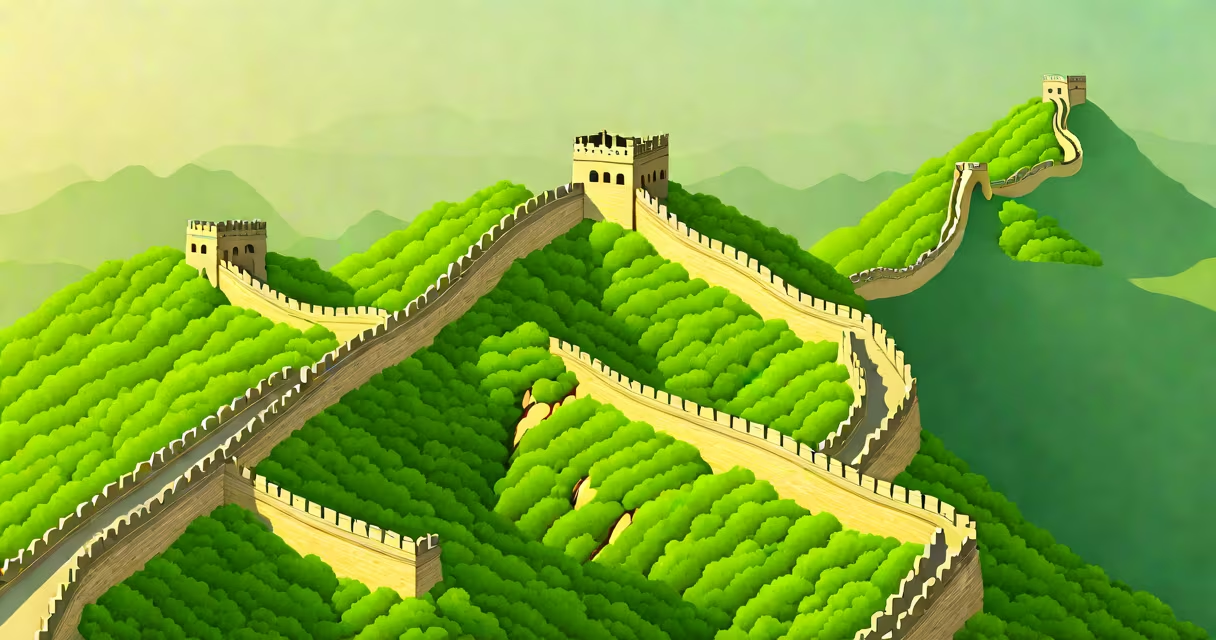
The Great Wall of China is a series of fortifications built between the 7th century BCE and the 17th century CE to protect Chinese states and empires against nomadic invasions from the Eurasian steppes. Its most famous sections were constructed during the Ming dynasty (1368-1644 CE) using bricks and stone.
The earliest walls date to the Warring States period (475-221 BCE). Seven warring states, including Qin, built defensive walls to protect their territories. When Qin Shi Huang unified China in 221 BCE, he ordered the linking of these walls to form a continuous barrier against northern invaders. These early walls were primarily earthworks and wooden palisades.
Early walls used rammed earth between board frames, a technique still visible in some sections. The Ming dynasty introduced bricks and stone, creating the iconic structures seen today. Workers transported materials using human and animal power, with some sections requiring laborers to carry bricks up steep mountainsides. The Ming walls averaged 7.5 meters (25 feet) high and 5 meters (16 feet) wide, though heights varied by terrain.
The wall served as both a physical barrier and a psychological deterrent. Watchtowers housed soldiers who could signal approaching threats via smoke or fire. Garrisons stationed along the wall provided rapid response capabilities. The wall's effectiveness varied: it repelled some Mongol raids but failed to prevent others, including the Manchu conquest in 1644.
Contrary to popular belief, the wall is not visible from space with the naked eye. Astronauts report seeing only the bright yellow desert and the dark green vegetation of the oases, with no clear sign of the wall itself.
Today, the Great Wall stretches over 21,000 kilometers (13,000 miles) across 15 provinces. UNESCO designated it a World Heritage Site in 1987. While some sections have deteriorated due to natural erosion and human activity, restoration efforts preserve critical portions. The wall remains a useful symbol of China's historical resilience and engineering prowess.
When I visited the Badaling section near Beijing, I was struck by the sheer scale of the construction. Standing atop the wall, I could imagine the watchmen scanning the horizon for threats centuries ago. The wall's enduring presence connects modern visitors to China's vast history.
The Great Wall's construction required immense resources. During the Ming dynasty, laborers transported materials using human and animal power. Some sections required workers to carry bricks up steep mountainsides, proof of the determination of ancient builders. The wall's strategic importance extended beyond its physical presence: it served as a psychological deterrent and a symbol of imperial power.
While the Great Wall is often associated with the Ming dynasty, its history spans multiple periods. The earliest walls date to the Warring States period (475-221 BCE), when seven warring states built defensive walls to protect their territories. When Qin Shi Huang unified China, he ordered the linking of these walls to form a continuous barrier against northern invaders.
The Great Wall's legacy extends beyond its military function. It has inspired countless stories, poems, and legends throughout Chinese history. Today, it stands as proof of China's historical resilience and engineering prowess, attracting millions of visitors each year.
For those interested in the economic aspects of the Great Wall, its construction had significant economic implications. The massive project required vast resources and labor, stimulating local economies and trade along the wall's route.