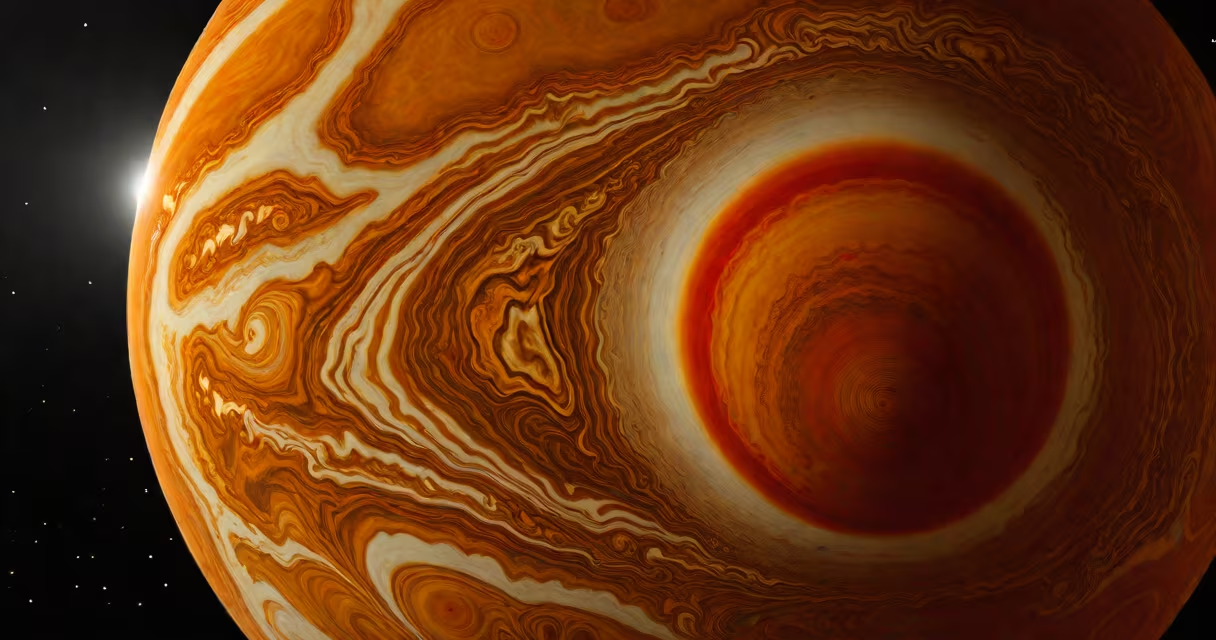
The largest planet in our solar system is Jupiter, a gas giant with a diameter of 86,881 miles (139,820 kilometers). Its massive size and useful gravity make it a key player in the solar system's dynamics.
Jupiter's diameter is over 11 times larger than Earth's, and its volume could fit 1,321 Earths. Despite its size, Jupiter spins rapidly-completing a rotation in about 10 hours-causing its distinctive oblate shape. The planet's surface area is roughly 6.1419 × 10^10 km², compared to Earth's 5.1 × 10^8 km².
Jupiter is primarily composed of hydrogen (about 90%) and helium (about 10%), with traces of other gases like methane, ammonia, and water vapor. Unlike rocky planets, Jupiter lacks a solid surface, transitioning from a gaseous atmosphere to increasingly dense layers of liquid metallic hydrogen under extreme pressure.
At its core, Jupiter may have a solid center, possibly 12 to 15 times Earth's mass, though this remains uncertain. The planet's intense gravity compresses its interior, creating extreme pressures and temperatures that contribute to its unique characteristics.
Jupiter's massive size is important for shaping the solar system. Its gravity influences the orbits of asteroids and comets, often deflecting them away from the inner solar system. This protective role may have helped prevent catastrophic impacts on Earth, contributing to the development of life.
Jupiter's size also makes it a prime target for studying planetary formation and evolution. Its complex weather systems, including the famous Great Red Spot-a storm larger than Earth-provide insights into atmospheric dynamics on a grand scale.
Many people mistakenly believe Jupiter is a failed star. While it emits some heat due to its contraction and internal processes, it lacks the mass to initiate nuclear fusion, the process that powers stars. Jupiter is a planet, not a brown dwarf or proto-star.
Another misconception is that Jupiter's Great Red Spot is a permanent feature that will last forever. In reality, the storm has been shrinking over time and may eventually dissipate.
During a public stargazing event, I observed Jupiter through a telescope for the first time. The sight of its distinct bands and the moons aligned in a row was breathtaking. This experience highlighted the beauty and complexity of our solar system's largest planet.
For more details on Jupiter's role in the solar system, explore the largest planet in the solar system. To understand how planets form, read about how to make a planet.