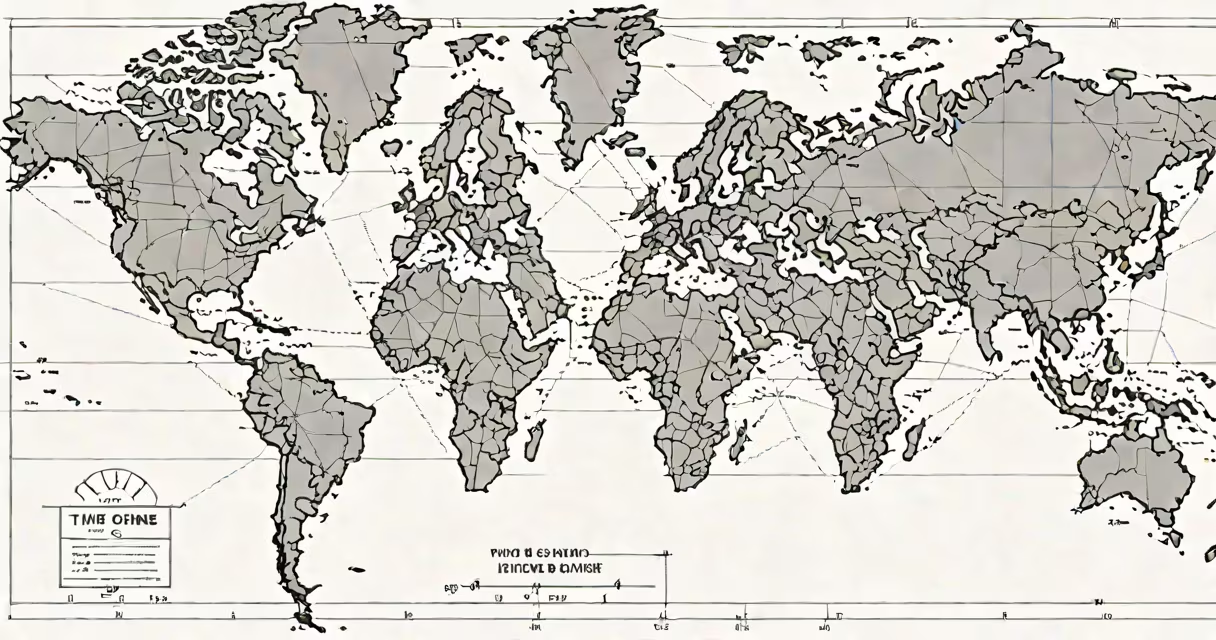
Time zone lines are imaginary boundaries dividing Earth into 24 vertical regions where clocks share the same standard time. These lines follow meridians of longitude but often deviate for political reasons.
Earth rotates 15 degrees every hour, creating 24 time zones. Each zone spans 15 degrees of longitude, offset by one hour from adjacent zones. The prime meridian (0° longitude) in Greenwich, England defines Coordinated Universal Time (UTC), the global time standard.
Time zone lines appear as jagged segments on maps because they follow country borders rather than strict meridians. For example, China spans five geographic time zones but uses a single time zone (China Standard Time, UTC+8) for political unity.
| Time Zone | UTC Offset | Example Location |
|---|---|---|
| Eastern Time Zone | UTC-5/-4 | New York City |
| Central European Time | UTC+1/+2 | Berlin |
| Japan Standard Time | UTC+9 | Tokyo |
The International Date Line, near 180° longitude in the Pacific Ocean, creates a +1 day or -1 day difference when crossing east or west. This prevents two consecutive days from existing simultaneously in adjacent time zones.
Another misconception is that time zones always align with country borders. Some countries span multiple time zones, like Russia (11 time zones) and the United States (6 time zones). Others use a single time zone despite their size, such as India (UTC+5:30).
When I traveled Delhi, I crossed five time zones but only adjusted my watch by 5.5 hours due to India's unique UTC+5:30 offset. This discrepancy exists because India's time zone was set during British rule and maintained for practical reasons.
Time zones coordinate global activities like air travel, financial markets, and communication. Without them, schedules would conflict, causing confusion in international trade and transportation.
For example, a flight from Los Angeles (Pacific Time, UTC-8) to Sydney (Australian Eastern Time, UTC+10) spans 18 hours and 18 time zones. Pilots rely on precise timekeeping to calculate flight duration and fuel requirements.
Understanding time zones helps travelers avoid jet lag by adjusting sleep schedules gradually. It also ensures accurate scheduling for virtual meetings across continents.
Time zones define standard times globally, while daylight saving time (DST) temporarily shifts clocks forward during summer months. DST affects only certain regions within time zones, creating temporary offsets like Eastern Daylight Time (UTC-4) in the U.S.