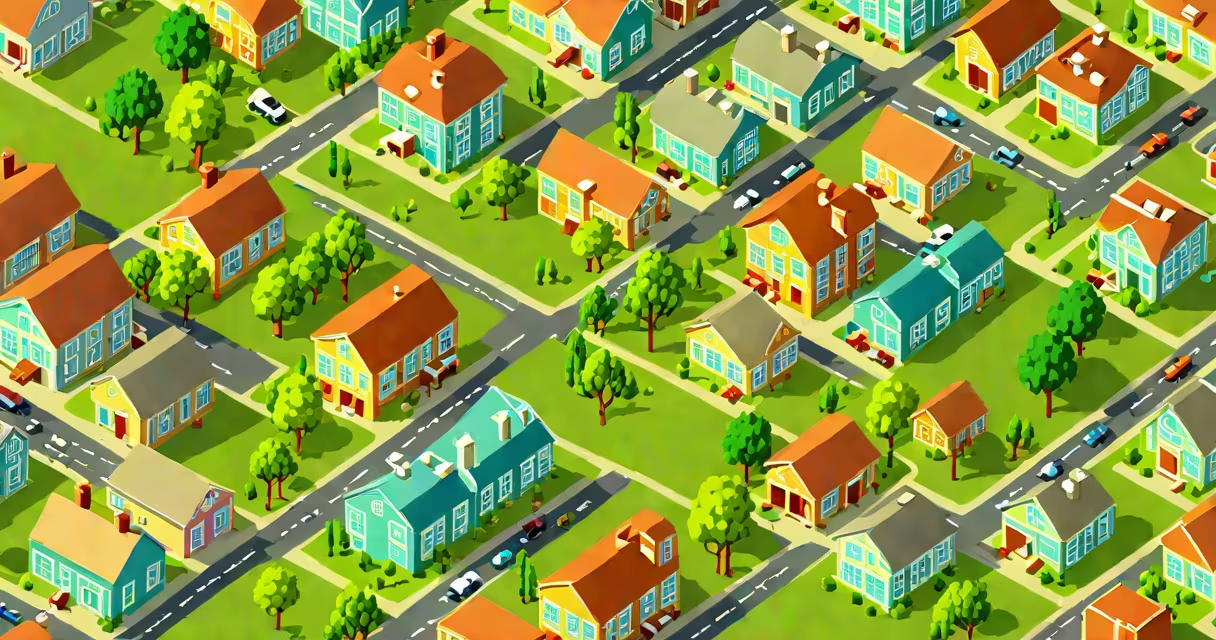
Urban areas are densely populated cities with high-rise buildings and public transportation, suburban areas are lower-density residential neighborhoods on city outskirts with single-family homes, and rural areas are sparsely populated regions with open land and agriculture.
These classifications help planners allocate resources like schools, hospitals, and infrastructure based on population needs and geographic constraints. The U.S. Census Bureau defines urban areas as having at least 50,000 people, while rural areas have fewer than 2,500 residents. Suburban areas fall between these two densities.
Each area type functions differently due to population density and available services. Urban centers prioritize efficiency with compact housing and walkable streets. Suburbs balance accessibility to cities with more space and privacy. Rural communities emphasize self-sufficiency with larger properties and natural resources.
| Type | Population Density | Primary Features |
|---|---|---|
| Urban | High (1,000+ people per square mile) | Skyscrapers, public transit, diverse businesses |
| Suburban | Medium (300-1,000 people per square mile) | Single-family homes, cars required, shopping centers |
| Rural | Low (<300 people per square mile) | Agriculture, open spaces, limited services |
Urban areas serve as economic hubs with job centers and cultural institutions. Suburbs provide affordable housing near employment centers. Rural regions supply food production and recreational spaces. According to the U.S. Department of Agriculture, 97% of America's land is rural, while 80% of the population lives in urban or suburban areas.
Consider Chicago: downtown is urban with skyscrapers and the "L" train system. Naperville is suburban with single-family homes and car dependency. Central Illinois farmland is rural with vast cornfields and limited services. Each area offers distinct advantages depending on lifestyle preferences.
I lived in Chicago's Lincoln Park neighborhood, experiencing urban life firsthand. My apartment building shared walls with neighbors, and I walked to grocery stores and work. When visiting family in rural Indiana, I drove 20 minutes to reach the nearest pharmacy, appreciating both lifestyles' trade-offs.