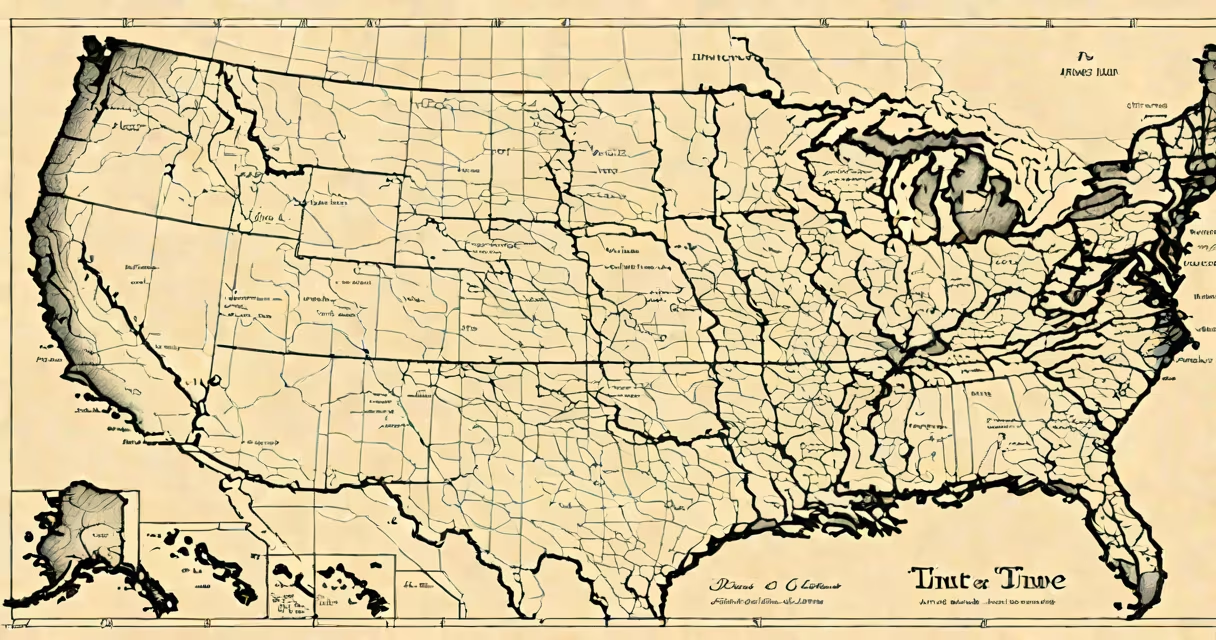
USA time zones are the six geographic regions that divide the United States based on local solar time, ensuring standardized timekeeping across the country. The system prevents confusion when scheduling events, flights, or communications between distant locations.
The USA uses six time zones: Eastern, Central, Mountain, Pacific, Alaska, and Hawaii-Aleutian. Each zone is offset by one hour from its neighbors, except for Alaska and Hawaii, which have unique offsets. The system accounts for Earth's rotation, ensuring noon sunlight aligns roughly with clock time in each zone.
Time zones shift during daylight saving time (DST), which begins on the second Sunday in March and ends on the first Sunday in November. During DST, clocks move forward one hour, extending evening daylight. Not all states observe DST-Arizona and Hawaii opt out.
| Time Zone | Abbreviation | UTC Offset | States Covered |
|---|---|---|---|
| Eastern Time | ET | UTC−5 (standard) / UTC−4 (DST) | Connecticut, New York, Florida (eastern), and others |
| Central Time | CT | UTC−6 (standard) / UTC−5 (DST) | Texas, Illinois, Minnesota, and others |
| Mountain Time | MT | UTC−7 (standard) / UTC−6 (DST) | Colorado, Utah, Arizona (except Navajo Nation) |
| Pacific Time | PT | UTC−8 (standard) / UTC−7 (DST) | California, Oregon, Washington |
| Alaska Time | AKT | UTC−9 (standard) / UTC−8 (DST) | Alaska |
| Hawaii-Aleutian Time | HAT | UTC−10 (standard) / UTC−9 (DST) | Hawaii, Aleutian Islands |
Time zones prevent chaos in scheduling across vast distances. For example, a 9 AM meeting in New York (Eastern Time) occurs at 6 AM in Los Angeles (Pacific Time). Without time zones, businesses, schools, and transportation systems would struggle to coordinate activities nationwide.
Travelers rely on time zones to adjust their schedules. A flight from Chicago (Central Time) to Denver (Mountain Time) departs at 3 PM local time but arrives at 2 PM local time due to the one-hour difference. Misunderstanding time zones can lead to missed flights or appointments.
Many assume all of Arizona follows Mountain Standard Time year-round, but the Navajo Nation observes DST. Similarly, parts of Indiana historically switched between Eastern and Central Time before standardizing on Eastern Time in 2006.
Another mistake is assuming Hawaii follows Pacific Time. Hawaii operates on Hawaii-Aleutian Time, which doesn't observe DST, making it two hours behind Pacific Time during DST.
I once scheduled a conference call with colleagues in Connecticut and Minnesota. Forgetting the one-hour difference, I set the meeting for 10 AM my time (Pacific Time), which meant it was 11 AM for them. The delay caused frustration, but it reinforced the importance of double-checking time zones before scheduling.
To verify the time in different US locations, use tools like world clocks or search engines. For example, searching "time in Connecticut" or "time in Minnesota" displays the current local time. These tools account for DST changes automatically.
Understanding USA time zones ensures smooth communication and scheduling across the country. Whether planning a business meeting, a family call, or travel arrangements, knowing the correct local time prevents confusion and delays.