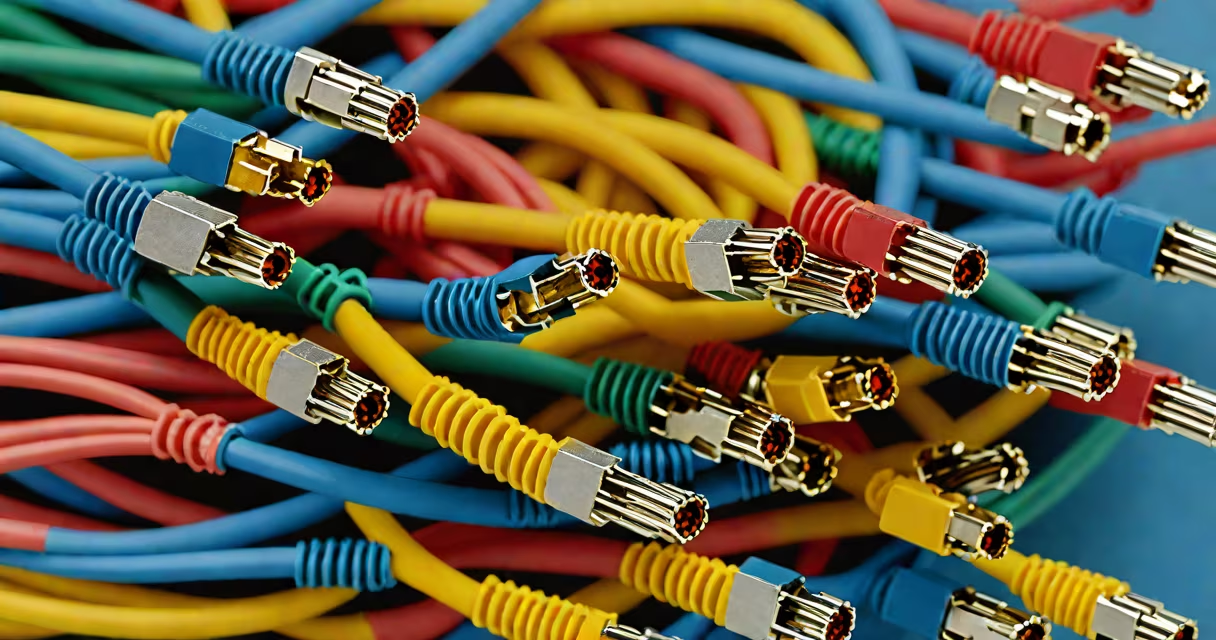
Cat cables are twisted-pair copper wires that carry data in Ethernet networks. They connect devices like computers, routers, and servers to transmit internet and local network traffic.
Each cable contains multiple pairs of copper wires twisted together to reduce electromagnetic interference. The twists vary in tightness along the cable's length to minimize crosstalk between pairs. Data travels as electrical signals through these wires, with different categories supporting varying speeds and frequencies.
| Category | Max Speed | Max Frequency | Typical Uses |
|---|---|---|---|
| Cat 5 | 100 Mbps | 100 MHz | Legacy networks, basic internet |
| Cat 5e | 1 Gbps | 100 MHz | Home networks, small offices |
| Cat 6 | 10 Gbps (up to 55 meters) | 250 MHz | Business networks, video conferencing |
| Cat 6a | 10 Gbps (up to 100 meters) | 500 MHz | Data centers, high-performance networks |
| Cat 7 | 10 Gbps | 600 MHz | High-density data centers |
| Cat 8 | 40 Gbps | 2000 MHz | Server connections, core cabling |
Network administrators choose specific cable categories based on required speed, distance, and environment. For example, a small office might use cat 6a to support video conferencing and file sharing, while a home user might install cat 5e for standard internet access. The Telecommunications Industry Association sets standards for each category's performance.
Many people confuse cat cables with phone lines, but they serve different purposes. Phone lines typically carry analog voice signals using lower-frequency transmissions, while cat cables transmit digital data at much higher frequencies., phone lines rarely exceed 100 feet without signal degradation, whereas properly installed cat cables maintain performance over longer distances.
Another misconception is that higher categories always mean better performance for all applications. While cat 8 offers the highest speeds, its shielding makes it more expensive and difficult to install. For most home and small business applications, cat 6a provides sufficient performance without unnecessary cost.
When I helped wire a small office building, we chose cat 6 cables despite the higher cost because the business planned to expand its video surveillance system. This decision saved them from needing a rewire later, demonstrating how understanding cable categories supports long-term planning.