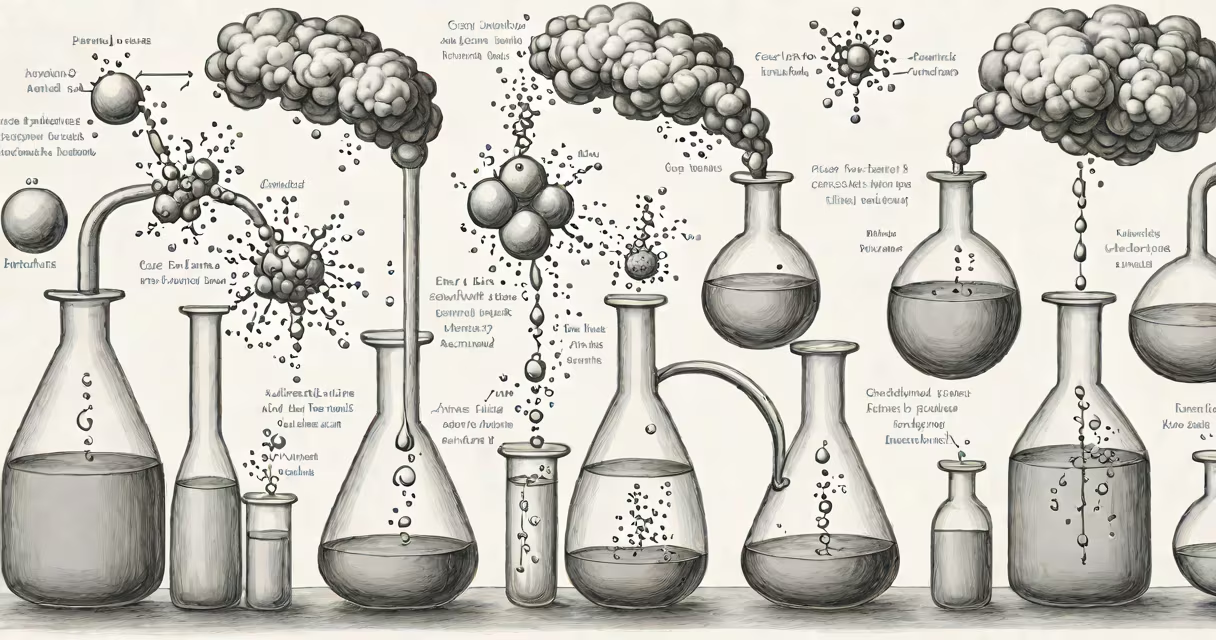
A chemical reaction is a process where substances interact, changing their molecular structure to form new products. This happens when atoms rearrange, bond, or break apart.
Reactions occur when reactants (starting materials) collide with enough energy to overcome activation barriers. For example, when hydrogen (H₂) and oxygen (O₂) react, they form water (H₂O) and release energy.
| Type | Description | Example |
|---|---|---|
| Synthesis | Combines reactants to form a single product | 2H₂ + O₂ → 2H₂O |
| Decomposition | Breaks down a compound into simpler substances | 2H₂O → 2H₂ + O₂ |
| Single Displacement | One element replaces another in a compound | Zn + CuSO₄ → ZnSO₄ + Cu |
| Double Displacement | Ions swap between two compounds | AgNO₃ + NaCl → AgCl + NaNO₃ |
Reactions occur because they tend toward lower energy states, releasing energy as heat, light, or sound. For instance, burning wood releases stored energy as heat and light.
People often confuse physical changes (like melting ice) with chemical reactions. Physical changes alter appearance but not molecular structure, while chemical reactions create entirely new substances.
Another myth is that all reactions require fire. While combustion reactions do, others (like photosynthesis) occur at room temperature using sunlight.
Rusting is an oxidation reaction where iron (Fe) reacts with oxygen (O₂) and water (H₂O) to form iron oxide (Fe₂O₃). This process weakens metal structures over time, costing industries billions annually in repairs and replacements.
To prevent rust, manufacturers coat metals with protective layers or use corrosion-resistant alloys like stainless steel.
Chemical reactions are fundamental to life and industry, transforming raw materials into useful products. Understanding them helps scientists develop new medicines, fuels, and materials.