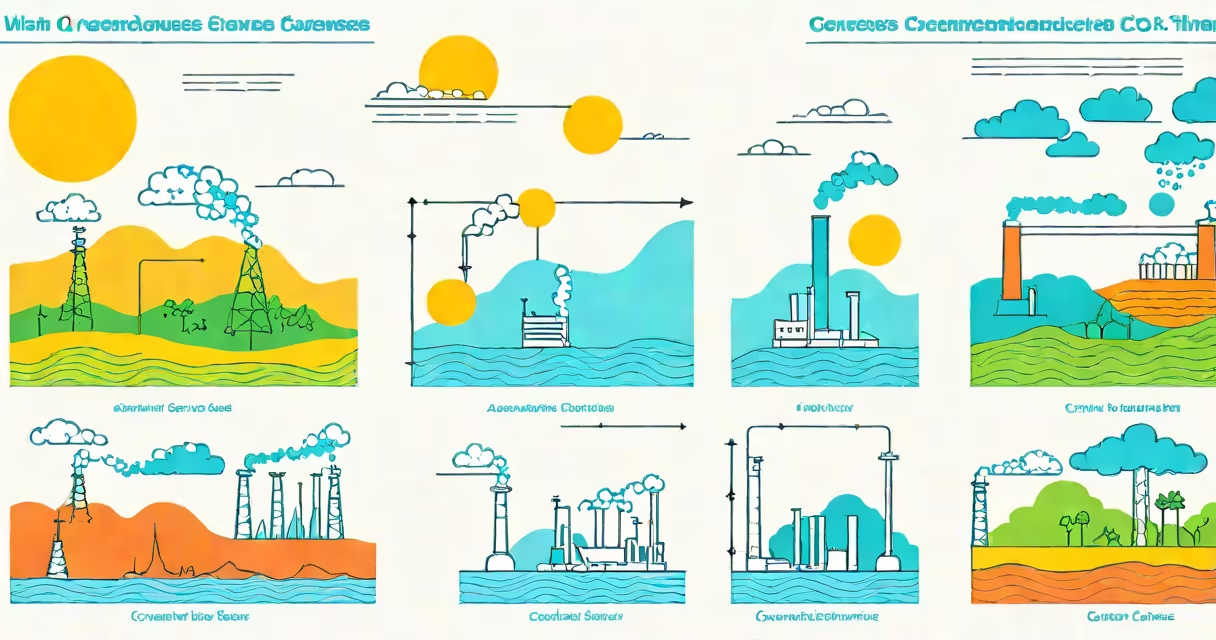
The two most significant greenhouse gases in Earth's atmosphere are carbon dioxide (CO₂) and methane (CH₄). These gases trap heat near the planet's surface, contributing to global warming and climate change.
Greenhouse gases absorb infrared radiation emitted by the Earth and reradiate it in all directions, including back toward the surface. This process, known as the greenhouse effect, keeps the planet warmer than it would be without an atmosphere. While essential for life, excessive concentrations of these gases improve the natural greenhouse effect, leading to global warming.
While there are several greenhouse gases, CO₂ and CH₄ are the most impactful due to their abundance and potency. Other gases, such as nitrous oxide (N₂O) and fluorinated gases, also contribute but to a lesser extent.
| Gas | Source | Atmospheric Lifetime | Global Warming Potential (100-year) |
|---|---|---|---|
| Carbon Dioxide (CO₂) | Burning fossil fuels, deforestation | 50-200 years | 1 |
| Methane (CH₄) | Agriculture, landfills, natural gas systems | 12 years | 28-36 |
Carbon dioxide is the most abundant greenhouse gas, accounting for about 76% of human-caused greenhouse gas emissions. It remains in the atmosphere for centuries, making it a long-term driver of climate change. Methane, though shorter-lived, is more potent than CO₂ over short timeframes. According to the Environmental Protection Agency (EPA), methane is 28-36 times more effective than CO₂ at trapping heat over a 100-year period.
For example, a leak in a natural gas pipeline can release large amounts of methane into the atmosphere. While the methane will break down relatively quickly, its immediate impact on warming is substantial. In contrast, CO₂ emissions from burning coal in a power plant will contribute to warming for hundreds of years.
Many people confuse greenhouse gases with other pollutants, such as sulfur dioxide (SO₂) or particulate matter (PM). While these substances can have harmful effects on air quality and health, they do not contribute to the greenhouse effect in the same way as CO₂ and CH₄., some believe that water vapor (H₂O) is the most significant greenhouse gas. Although it is abundant, its role is complex and generally stabilizing, unlike CO₂ and CH₄, which are primarily driven by human activities.
I once visited a wastewater treatment plant where methane was being captured and used to generate electricity. This process provides a renewable energy source. It was fascinating to see firsthand how methane management can mitigate climate change impacts.
The increased concentration of CO₂ and CH₄ in the atmosphere has led to rising global temperatures, changing precipitation patterns, and more frequent extreme weather events. Understanding the roles of these gases is important for developing strategies to mitigate climate change. For more detailed information on the four main greenhouse gases, see here.
To explore the broader implications of greenhouse gases, including their environmental and economic impacts, read more here.