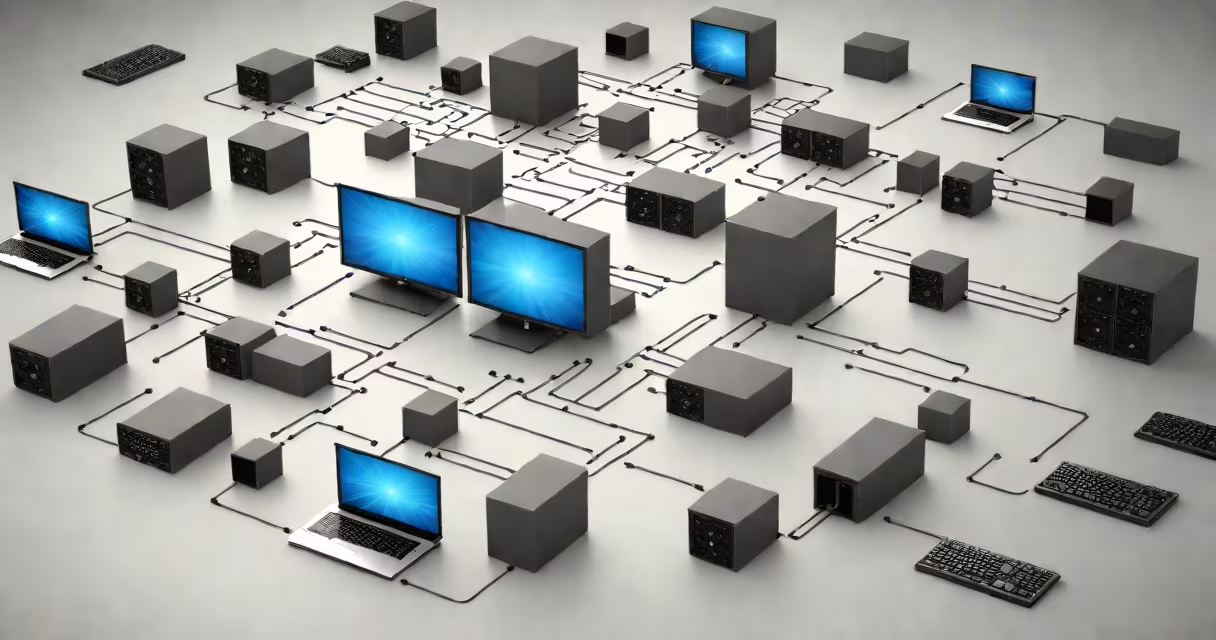
LAN stands for Local Area Network, while WAN stands for Wide Area Network. These are two fundamental types of computer networks that differ in size, purpose, and scope.
A LAN connects devices within a limited area such as a home, office, or campus. It uses wired connections (Ethernet cables) or wireless technology (Wi-Fi) to link computers, printers, and other devices. LANs enable file sharing, resource access, and communication between connected devices.
A WAN connects multiple LANs over larger geographical areas using public networks like the internet or private leased lines. WANs use routers and switches to transmit data between distant locations. They support long-distance communication, data transfer, and resource sharing across different sites.
| Network Type | Characteristics | Examples |
|---|---|---|
| LAN | High-speed, low-latency, private | Home Wi-Fi, office network |
| WAN | Low-speed, high-latency, public/private | Internet, corporate VPN |
LANs are used in homes, schools, and businesses to connect devices within a small area. They provide fast, reliable access to shared resources and enable local communication. For example, a small business might use a LAN to connect computers, printers, and servers in their office.
WANs are used to connect LANs across large distances. They enable global communication, data transfer, and resource sharing between different locations. For instance, a multinational corporation might use a WAN to connect its offices in different countries.
One common misconception is that LANs are always faster than WANs. While LANs typically offer higher speeds, the actual performance depends on the specific technologies and configurations used. A well-configured WAN can sometimes outperform a poorly configured LAN.
Another misconception is that WANs are always public. While many WANs use public networks like the internet, private WANs (such as those using leased lines) are also common. These private WANs offer enhanced security and reliability compared to public WANs.
I once helped set up a LAN for a small café. We connected all the computers, printers, and POS systems using Ethernet cables and a central switch. This allowed the staff to share files, access shared resources, and communicate efficiently within the café. To connect the café's LAN to the company's headquarters, we used a WAN over the internet. This enabled secure data transfer and communication between the café and the central office.
According to Cisco, LANs are typically used for distances up to a few kilometers, while WANs can span entire continents. The choice between LAN and WAN depends on the specific needs and constraints of the network.