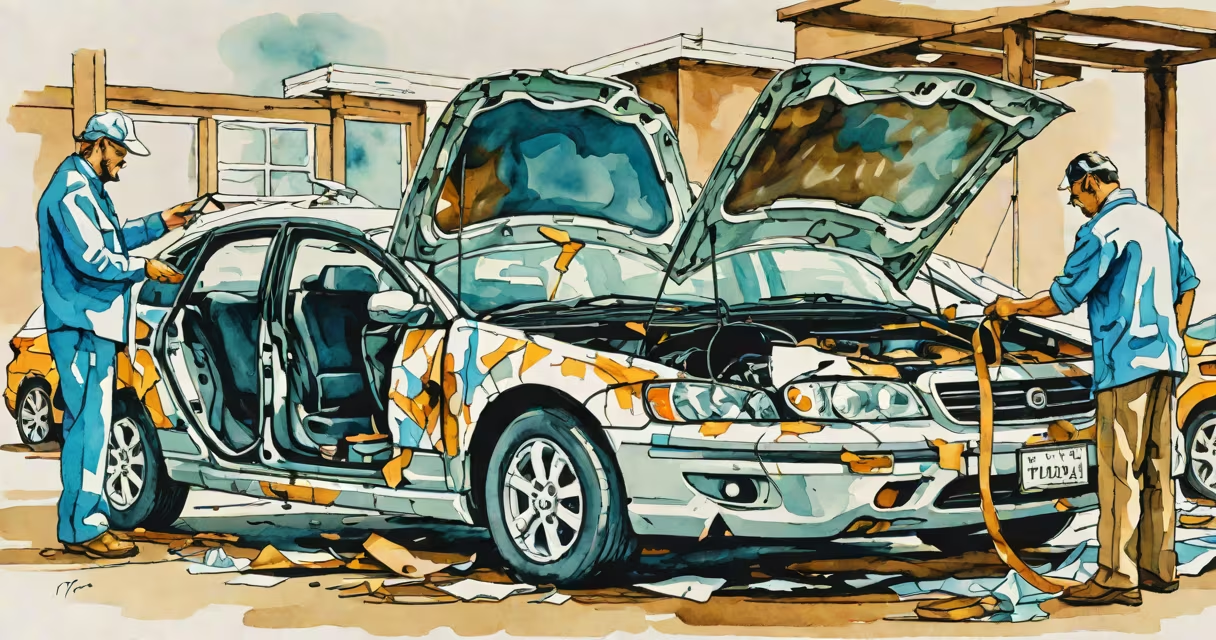
A car insurance adjuster investigates accidents, assesses vehicle damage, determines liability, and negotiates settlements. They act as investigators and negotiators between policyholders and insurers.
Adjusters begin by gathering facts about the accident. This includes reviewing police reports, interviewing drivers and witnesses, and examining photos of the damage. For example, if two cars collide at an intersection, the adjuster would compare witness statements with physical evidence like skid marks to determine who was at fault.
| Type | Specialization | Typical Workload |
|---|---|---|
| Staff Adjuster | Works directly for an insurance company | Handles claims assigned by their employer |
| Independent Adjuster | Contracted for specific claims | Manages high-volume claims or catastrophic events |
| Catastrophe Adjuster | Specializes in large-scale disasters | Deploys to areas affected by hurricanes, floods, etc. |
Adjusters don't just evaluate car damage. They also verify policy coverage, calculate repair costs using industry tools, and ensure compliance with state regulations. For instance, in states with no-fault laws, adjusters must follow specific procedures for processing personal injury protection (PIP) claims.
Adjusters often work with car insurance claims to ensure fair settlements. They may consult with auto repair shops to get accurate estimates and negotiate with body shops to control costs. In complex cases, they might hire accident reconstruction specialists to analyze the crash dynamics.
Many people assume adjusters always side with insurance companies, but their primary role is to ensure claims are processed fairly and accurately. While they represent the insurer's interests, they must follow legal and ethical guidelines. For example, adjusters cannot deny a valid claim simply to save the company money-they must have documented evidence to support their decisions.
Another misconception is that adjusters only handle collision claims. They also process claims for theft, vandalism, and natural disasters. For instance, if a tree falls on a car during a storm, an adjuster would assess the damage and determine whether the policy covers such incidents.
When a policyholder reports a hit-and-run, the adjuster must determine if the damage matches the description. They check surveillance footage, review medical records if injuries occurred, and consult with law enforcement. If the at-fault driver is unidentified, the adjuster works with the insurer to cover the damages under the policyholder's collision or uninsured motorist coverage.
I once observed an adjuster handle a complex hit-and-run case where the victim had limited evidence. The adjuster successfully pieced together the timeline using security camera footage from nearby businesses, demonstrating how thorough investigations can resolve even the most challenging claims.
While both roles assess vehicle damage, adjusters focus on liability and settlement negotiations, whereas appraisers provide detailed repair cost estimates. Adjusters may consult appraisers for complex repairs, but they make the final decision on settlement amounts.
For example, if a luxury car requires extensive repairs, an adjuster might consult an appraiser to determine if the repair costs exceed the car's actual cash value (ACV). The adjuster then decides whether to pay for repairs or declare the car a total loss.
Adjusters play a critical role in determining how quickly and fairly your claim is resolved. Their expertise helps settlements are based on accurate assessments rather than guesswork. If you're involved in an accident, providing detailed documentation-such as photos, police reports, and witness statements-can help the adjuster process your claim efficiently.
Adjusters are essential to the claims process, ensuring fairness and accuracy in settlements. a major collision, their role is to investigate, assess, and negotiate on behalf of both the insurer and the policyholder. By understanding their responsibilities, you can better go through the claims process and work toward a resolution that benefits everyone involved.