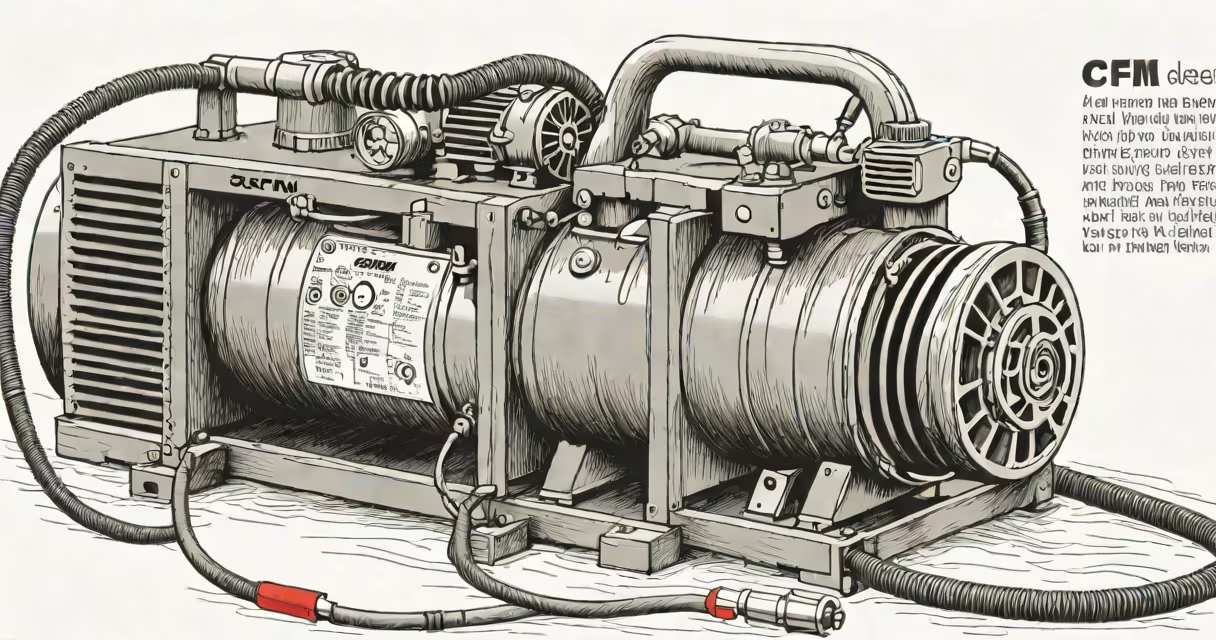
CFM on an air compressor measures air volume moved per minute at a specific pressure level. This metric determines whether your compressor can support your tools.
CFM stands for cubic feet per minute, quantifying airflow at 90 PSI (pounds per square inch). A higher CFM rating means the compressor delivers more air volume, important for continuous tool operation.
For example, a 60-gallon compressor with a 17 CFM rating at 90 PSI can run a 5 HP air compressor continuously without overheating. The compressor's tank size and pump capacity together determine its CFM output.
Compressors list two CFM ratings:
| Rating Type | Description |
|---|---|
| Standard CFM | Measured at 90 PSI, indicates maximum continuous output |
| Maximum CFM | Short-term peak output during initial startup |
Always use standard CFM for tool matching. A 10 HP air compressor might advertise 22 CFM max but only deliver 17 CFM standard - the lower figure matters most.
Tools require specific CFM to function properly. Undersized compressors cause pressure drops, overheating, and tool damage. For instance, an impact wrench needs 4.5 CFM while an air sander requires 8 CFM.
When I set up my home workshop, I matched my 6-gallon compressor's 5.7 CFM rating to my tools' requirements. This prevented constant cycling and maintained proper pressure for finish work.
Many confuse CFM with PSI (pounds per square inch), which measures pressure. While both affect tool performance, they serve different purposes. A tool needing 90 PSI might require only 2 CFM, while another needing the same PSI could require 6 CFM.
Check both specifications when selecting tools and compressors. The U.S. Department of Energy notes that proper sizing prevents energy waste and equipment strain.
Add up the CFM requirements of all tools you'll use simultaneously, then add 30% for safety margin. For example, if your impact wrench needs 4.5 CFM and your spray gun needs 6 CFM, you'd need at least 13.65 CFM capacity.
Most DIY projects don't require massive CFM, but professional shops often need 30+ CFM systems to run multiple tools continuously.