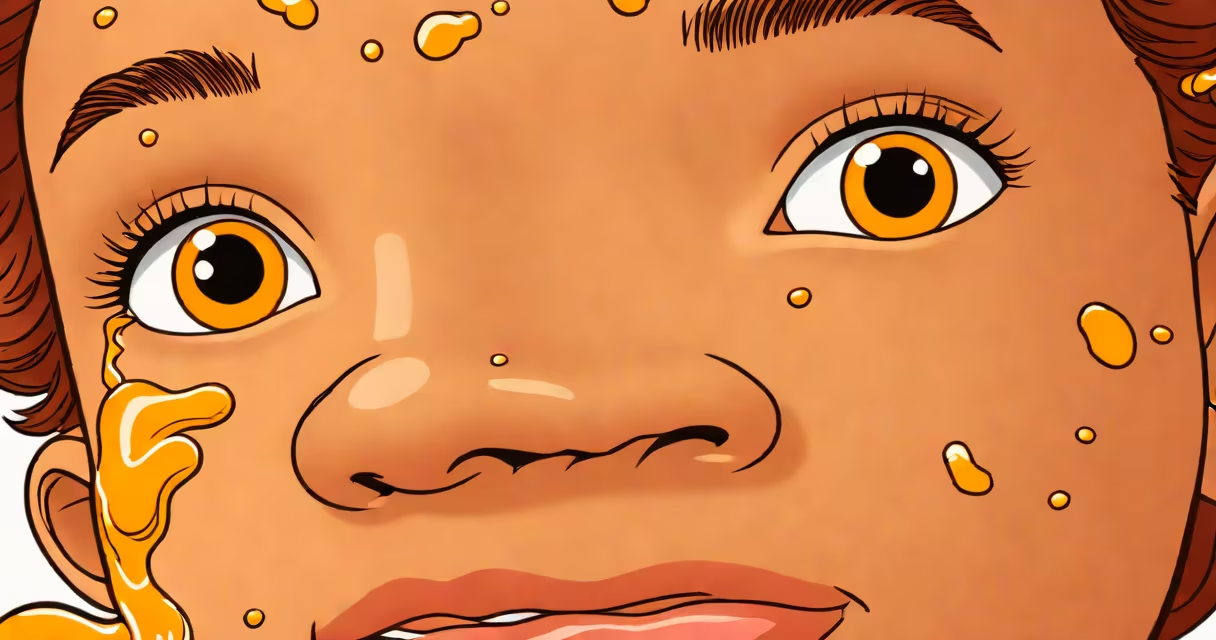
Impetigo is a contagious bacterial skin infection characterized by red sores or blisters that burst and ooze, forming honey-colored crusts, typically around the mouth, nose, hands, or feet.
The infection is caused by Staphylococcus aureus (staph) or Streptococcus pyogenes (strep) bacteria. It primarily affects children but can occur in adults, especially those with weakened immune systems or broken skin.
Impetigo begins as small red spots that quickly turn into fluid-filled blisters. These blisters burst easily, leaving behind a sticky, yellowish-brown crust. The crusts may spread and form larger patches if untreated.
In non-bullous impetigo, the most common type, the sores appear around the mouth, nose, and hands. Bullous impetigo causes larger blisters, often on the trunk and limbs, which are more likely to rupture and form crusts.
| Type | Appearance | Common Locations |
|---|---|---|
| Non-bullous impetigo | Small red spots that turn into blisters, then burst and form honey-colored crusts | Around the mouth, nose, hands, and feet |
| Bullous impetigo | Larger blisters filled with fluid that rupture and form crusts | Trunk, arms, legs, and sometimes the face |
| Ecthyma | Deeper, painful sores that form scabs and may leave scars | Legs, buttocks, and hands |
Impetigo thrives in warm, humid conditions and spreads through direct contact with infected skin, shared items, or poor hygiene. It's common in schools, daycare centers, and sports teams due to close contact.
Children are particularly susceptible because their immune systems are still developing, and they're more likely to have minor skin injuries that allow bacteria to enter.
Many people confuse impetigo with other skin conditions like eczema or psoriasis. Unlike these chronic conditions, impetigo is acute and highly contagious. It's also often mistaken for herpes simplex, but impetigo lacks the characteristic grouping of blisters seen in herpes.
Another misconception is that impetigo always causes severe pain. While some forms, like ecthyma, can be painful, non-bullous impetigo often causes little discomfort beyond itching or tenderness.
When examining a potential case of impetigo, look for clusters of small blisters or crusted sores. The crusts are usually yellow or brown and may appear shiny. The surrounding skin might be red and inflamed.
If you suspect impetigo, consult a healthcare professional for proper diagnosis and treatment. Antibiotics are typically prescribed to clear the infection and prevent complications.
I once treated a case of impetigo in my child's daycare class. The teacher noticed small crusty sores around a child's mouth and immediately contacted parents. The infected child received antibiotics, and the outbreak was contained within days.