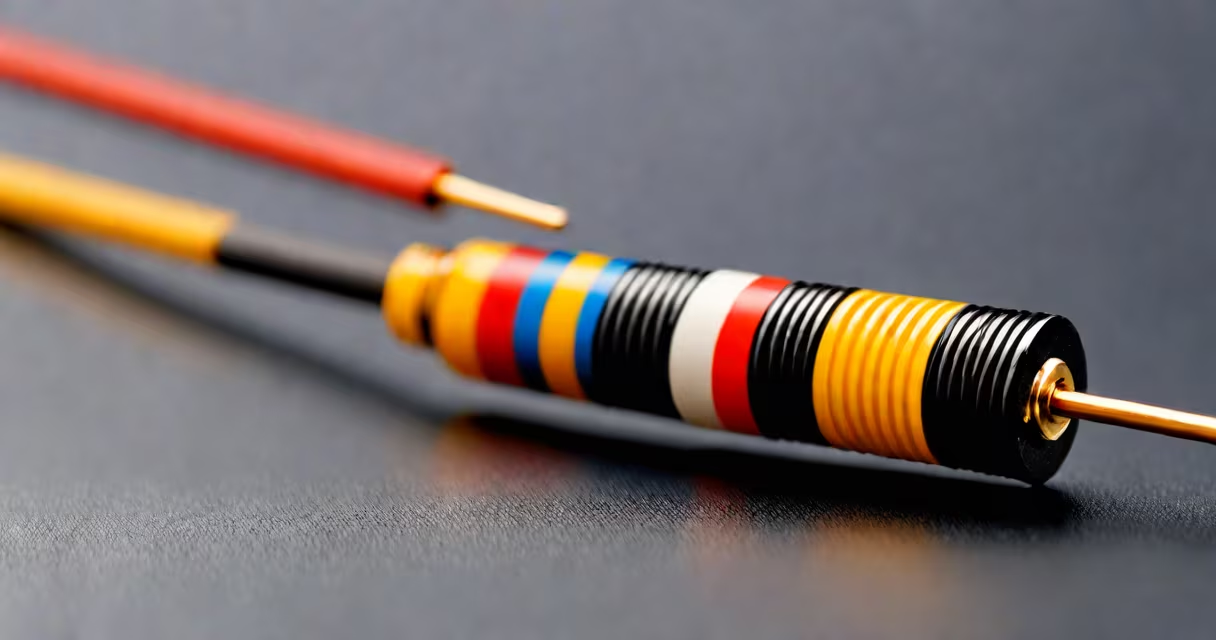
A fixed resistor is a passive electronic component designed to provide a specific, unchanging resistance value in electrical circuits. These resistors maintain their resistance regardless of voltage or current changes, making them essential for controlling current flow, dividing voltage, and biasing active components.
Fixed resistors operate by converting electrical energy into heat through resistance. When current flows through the resistor, it encounters opposition proportional to its resistance value (measured in ohms, Ω). This resistance limits current, divides voltage, or sets bias points in circuits. The power rating (measured in watts) determines how much heat the resistor can dissipate before failing.
| Type | Material | Typical Resistance Range | Tolerance |
|---|---|---|---|
| Carbon Composition | Carbon granules mixed with clay | 0.1Ω to 22MΩ | ±5% to ±20% |
| Carbon Film | Carbon deposited on ceramic core | 1Ω to 10MΩ | ±1% to ±5% |
| Metal Film | Nickel-chromium alloy | 0.1Ω to 10MΩ | ±0.1% to ±1% |
| Wirewound | Nickel-chrome or copper-nickel wire | 0.01Ω to 100kΩ | ±0.1% to ±1% |
Most modern circuits use metal film resistors due to their precision and stability. Wirewound resistors handle high power levels, while carbon composition resistors are obsolete but still found in vintage equipment.
Fixed resistors appear in nearly all electronic devices. They:
For example, a 220Ω resistor in series with an LED ensures safe current flow. A voltage divider using two resistors (e.g., 10kΩ and 4.7kΩ) creates a reference voltage for analog-to-digital converters.
Unlike fixed resistors, variable resistors (potentiometers and rheostats) allow adjustable resistance. Fixed resistors maintain constant values, while variables use sliding contacts or adjustable taps. Fixed resistors are far more common due to their simplicity, reliability, and lower cost.
I once diagnosed a malfunctioning amplifier by replacing a degraded carbon film resistor with a modern metal film equivalent. The improved tolerance (from ±5% to ±1%) eliminated distortion and restored clarity to the audio output.
The Electronic Industries Alliance (EIA) defines standard resistance values as part of the E series. The E24 series, for example, includes values like 10Ω, 12Ω, 15Ω, 18Ω, 22Ω, 27Ω, 33Ω, 39Ω, 47Ω, 56Ω, and 68Ω. These standardized values simplify manufacturing and ensure compatibility across different components.
Use fixed resistors when: