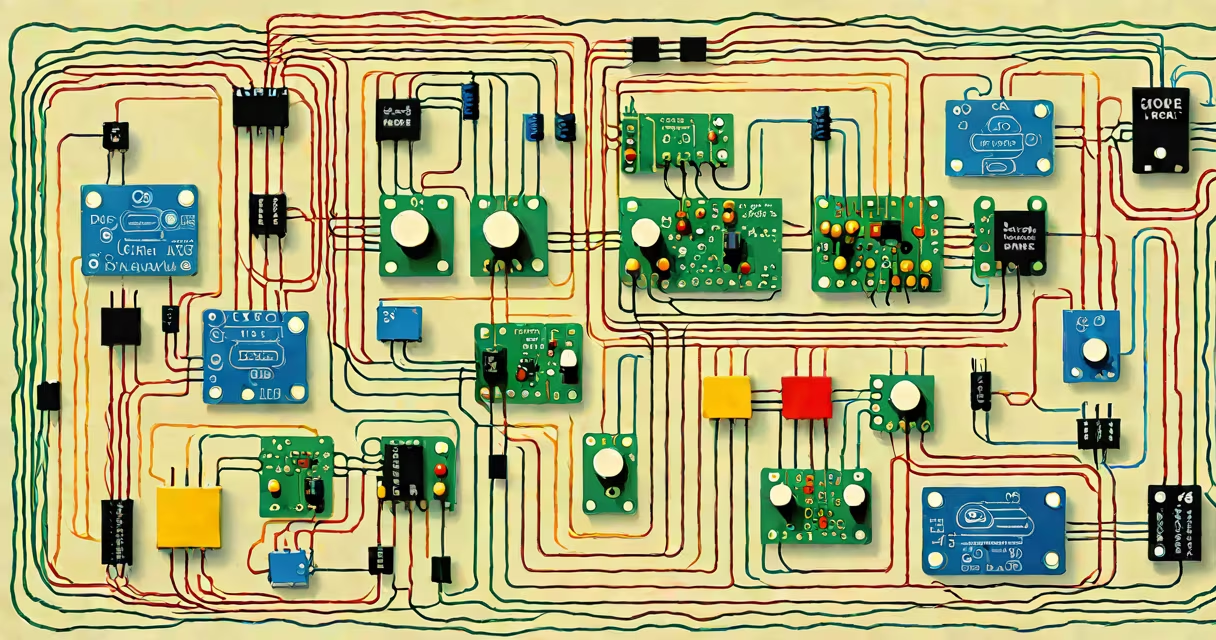
An electronic circuit is a path that allows electricity to flow through components like resistors, capacitors, and transistors to perform specific tasks. Circuits power everything devices.
Circuits provide a closed loop for electrons to travel along, typically from a power source like a battery. Components regulate current, voltage, and signal direction to create useful functions. For example, a basic circuit might light an LED when a switch closes.
Circuits contain passive and active parts:
These components connect via conductive pathways on printed circuit boards (PCBs) or breadboards during prototyping.
| Type | Function | Example Application |
|---|---|---|
| Series Circuit | Single path for current | Christmas lights |
| Parallel Circuit | Multiple paths | Household wiring |
| Feedback Circuit | Self-regulating | Thermostats |
| Oscillator Circuit | Generates waveforms | Clocks |
Engineers use software tools like SPICE to simulate circuits before building physical prototypes. These simulations test functionality and identify potential issues. For example, a team designing a new smartphone component might run 50+ simulations before producing a single physical board.
When ready for production, designs transfer to PCBs using automated manufacturing processes. The complexity varies from simple single-layer boards to multi-layer boards with hundreds of connections.
I once built a simple LED circuit that didn't light up because I overlooked a cold solder joint. This taught me the importance of careful inspection during the physical assembly phase, even after successful simulations.