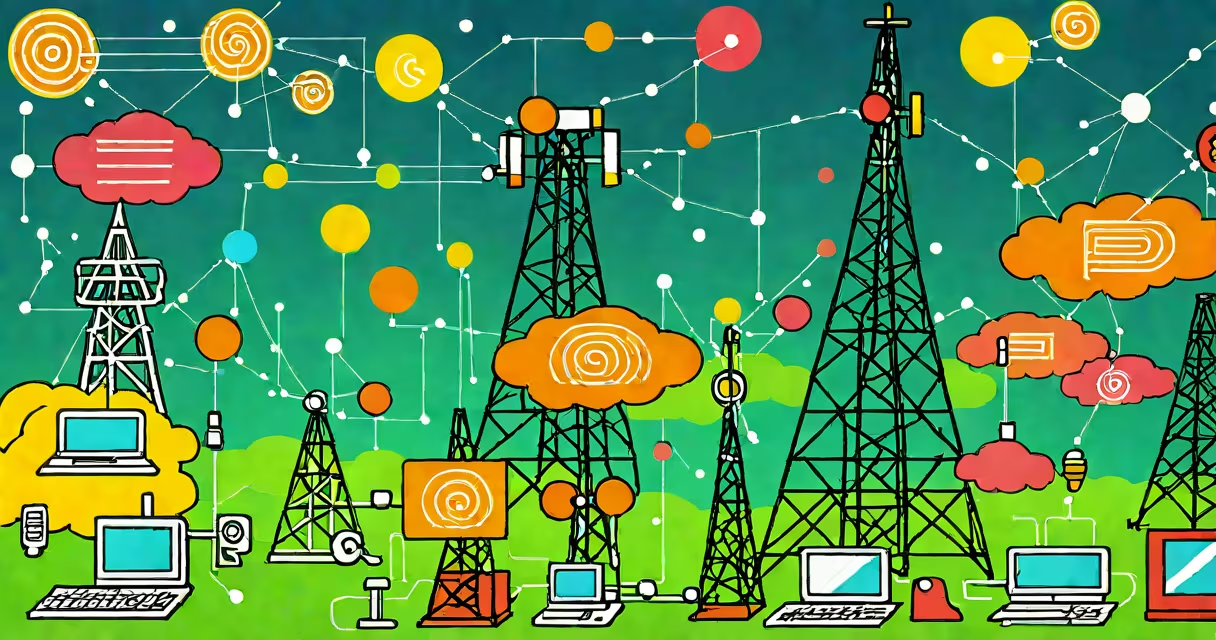
A CDMA network is a wireless communication system that uses spread spectrum techniques to transmit multiple signals simultaneously over a shared channel. It achieves this by assigning unique codes to each signal, allowing multiple users to share the same frequency bandwidth without interference.
CDMA stands for Code Division Multiple Access. Unlike other cellular technologies that divide bandwidth by time (TDMA) or frequency (FDMA), CDMA spreads the signal across the entire bandwidth using pseudo-random noise and orthogonal codes. When a device wants to communicate, it uses its unique code to modulate the signal, making it appear as noise to other devices. The receiving station uses the same code to demodulate the signal, effectively filtering out other transmissions.
The key advantage of CDMA is its ability to handle many simultaneous users efficiently. As more users join the network, the signal-to-noise ratio decreases slightly, but the network remains functional. This makes CDMA particularly effective in densely populated areas.
A CDMA network consists of several key components:
CDMA technology was widely adopted in North America through carriers like Verizon and Sprint. It's particularly suited for urban environments where many users need to access the network simultaneously. The technology's efficiency in handling multiple users makes it ideal for high-density areas.
One common misconception is that CDMA networks are outdated. While newer technologies like LTE and 5G have emerged, CDMA still is important for many regions, especially in rural areas where infrastructure is limited. Some carriers have even deployed hybrid networks that combine CDMA with newer technologies to provide smooth coverage.
To understand CDMA better, let's compare it with other network technologies:
| Technology | Access Method | Key Characteristic |
|---|---|---|
| CDMA | Code Division Multiple Access | Uses unique codes to separate signals |
| GSM | Time Division Multiple Access (TDMA) | Divides time slots for different users |
| WiMAX | Orthogonal Frequency-Division Multiple Access (OFDMA) | Uses multiple subcarriers for data transmission |
Each technology has its strengths. For instance, GSM is simpler to implement and widely used globally, while WiMAX offers high data rates over long distances. CDMA's strength lies in its ability to maintain performance even as more users join the network.
I once tested a CDMA network in a crowded stadium. Despite thousands of users trying to access the network simultaneously, the performance remained stable. This real-world example highlights CDMA's efficiency in handling high user density.
One persistent myth is that CDMA networks are slower than other technologies. In reality, CDMA's speed depends on the specific implementation and generation. For example, CDMA2000, a 3G evolution of CDMA, offers speeds comparable to other 3G technologies. The perception of slowness often stems from comparing older CDMA networks with newer technologies like LTE.
Another misconception is that CDMA is incompatible with newer technologies. In practice, many networks have evolved to support both CDMA and newer standards, ensuring backward compatibility while providing access to advanced features.
While newer technologies like 5G are taking center stage, CDMA continues to play a important role in many regions. Its efficiency in handling multiple users makes it a valuable technology, especially in areas where infrastructure is limited. As networks evolve, CDMA is likely to coexist with newer standards, providing reliable coverage in various scenarios.