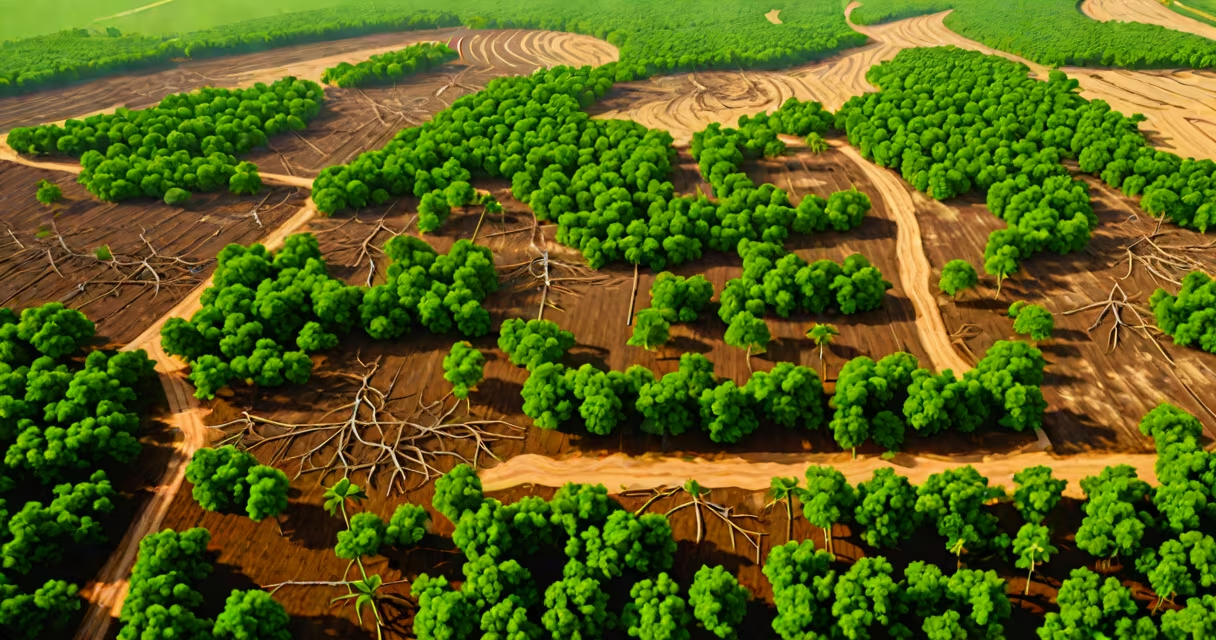
Deforestation is the permanent removal of standing forests for human use, typically through clear-cutting, burning, or chemical treatments. This process converts forest land into agricultural fields, urban developments, or logging sites, often resulting in irreversible ecological damage.
Forests are cleared through mechanical means such as bulldozers, chainsaws, and heavy machinery. In some cases, controlled burns are used to clear large areas quickly. The remaining tree stumps are often removed using specialized equipment. Once the land is cleared, it is typically used for farming, ranching, or urban development.
The rate of deforestation varies by region and country. According to the Food and Agriculture Organization of the United Nations, the world loses about 10 million hectares of forest each year. This is equivalent to losing a football field worth of trees every three seconds.
Deforestation can be categorized into several types based on the primary cause:
| Type | Primary Cause | Example Regions |
|---|---|---|
| Agricultural Expansion | Conversion of forest land to farms and pastures | Amazon Basin, Southeast Asia |
| Urban Development | Expansion of cities and infrastructure | North America, Europe |
| Logging | Commercial timber harvesting | Canada, Russia, Scandinavia |
| Mining | Extraction of minerals and resources | South America, Africa |
Deforestation occurs worldwide, but tropical regions experience the highest rates. The Amazon rainforest, for instance, loses about 17% of its forest cover annually due to agricultural expansion and logging. In contrast, temperate forests in North America and Europe face slower rates of deforestation, primarily due to stricter environmental regulations and reforestation efforts.
The primary drivers of deforestation include economic factors such as the demand for timber, agricultural products, and urban expansion., poverty and lack of alternative livelihoods in rural areas contribute to deforestation as people rely on forest resources for survival.
One common misconception is that deforestation only affects tropical regions. However, temperate and boreal forests also experience significant deforestation, albeit at slower rates. Another misconception is that deforestation is solely caused by logging. While logging is a major contributor, agricultural expansion and urban development are equally responsible for forest loss.
Some believe that deforestation is a natural process. However, natural disturbances such as wildfires and disease outbreaks are part of the forest life cycle and often result in regeneration. In contrast, human-induced deforestation leads to permanent loss of forest cover and biodiversity.
Consider the case of the Amazon rainforest. Over the past few decades, extensive deforestation has occurred due to the expansion of soybean farming and cattle ranching. Satellite imagery shows that between 2000 and 2020, the Amazon lost approximately 17% of its forest cover, totaling around 750,000 square kilometers. This deforestation has led to significant biodiversity loss, including the extinction of numerous plant and animal species.
Efforts to combat deforestation in the Amazon include the implementation of sustainable farming practices, reforestation programs, and stricter enforcement of environmental laws. Organizations such as the World Wildlife Fund have also played a important role in raising awareness and promoting conservation efforts.
During a visit to the Brazilian Amazon, I witnessed firsthand the stark contrast between pristine rainforest and deforested land. The deforested areas were characterized by barren soil and scattered tree stumps, a stark reminder of the irreversible damage caused by human activities. This experience highlighted the urgent need for sustainable practices and conservation efforts to protect our planet's remaining forests.
Deforestation has severe consequences for the environment, economy, and society. It contributes to climate change by releasing stored carbon dioxide into the atmosphere. Deforestation also leads to soil erosion, loss of biodiversity, and disruption of water cycles. For more details on the effects of deforestation, see this guide.
Economically, deforestation can lead to short-term gains but long-term losses. While the timber and agricultural industries benefit from deforestation, the long-term costs include decreased soil fertility, reduced water quality, and loss of ecotourism opportunities. Socially, deforestation can displace indigenous communities and lead to conflicts over land use.