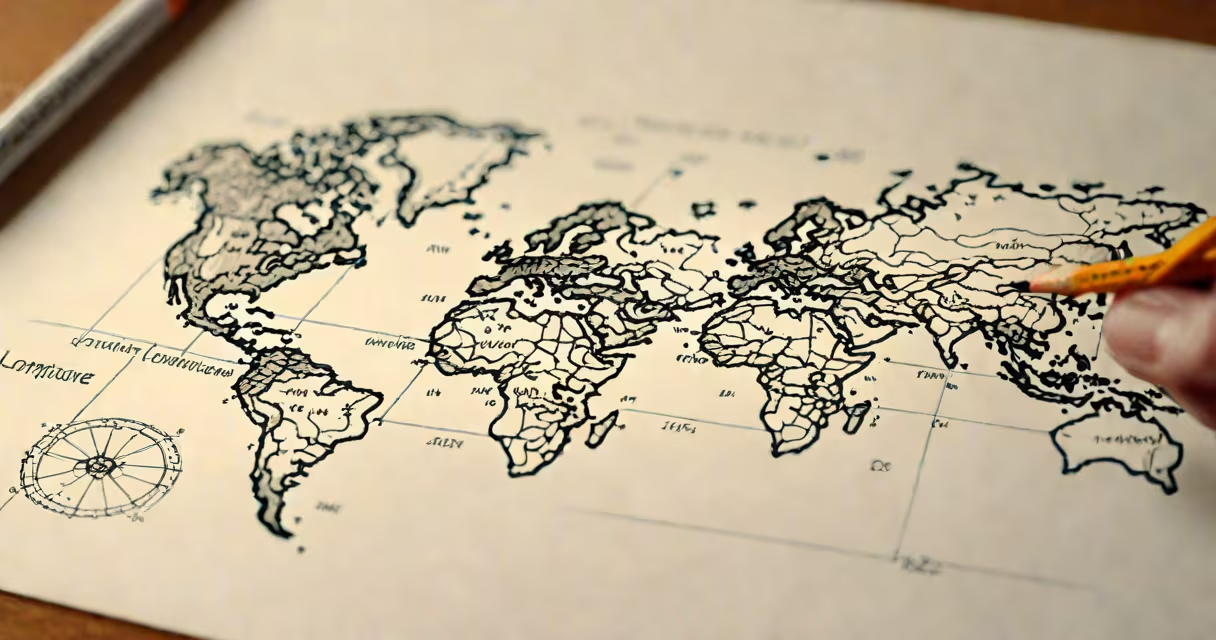
Your latitude and longitude are geographic coordinates that pinpoint your exact location on Earth. To find them, use a GPS-enabled device like a smartphone or visit a geolocation website.
Latitude measures how far north or south you are from the Equator, ranging from 0° to 90°. Longitude measures how far east or west you are from the Prime Meridian, ranging from 0° to 180°. Together, they create a precise address for any location.
| System | Format | Example |
|---|---|---|
| Decimal Degrees (DD) | Degrees, decimal minutes | 40.7128° N, 74.0060° W |
| Degrees Minutes Seconds (DMS) | Degrees, minutes, seconds | 40°42'46.8" N, 74°0'21.6" W |
| Universal Transverse Mercator (UTM) | Zone, easting, northing | 18T 584430 4509106 |
Latitude and longitude are essential for navigation, mapping, and location-based services. Smartphones use them for apps like Google Maps, ride-sharing services, and weather tracking. Pilots and sailors rely on these coordinates for precise navigation.
Many people confuse latitude and longitude, swapping their roles. Latitude lines run horizontally (east-west), while longitude lines run vertically (north-south). Another mistake is assuming coordinates are always given in decimal degrees, when they can also appear in DMS format.
For example, New York City's coordinates are approximately 40.7128° N, 74.0060° W in decimal degrees. In DMS, they are 40°42'46.8" N, 74°0'21.6" W. Both formats are correct but used in different contexts.
To find your current latitude and longitude, open Google Maps on your smartphone. Tap and hold your location to see the coordinates at the bottom of the screen. Alternatively, visit a geolocation website like LatLong.net.
I once needed to find my exact location while hiking in a remote area. Using my smartphone's GPS, I quickly determined my coordinates and shared them with emergency services when needed. This experience highlighted the importance of knowing how to find and use latitude and longitude in real-time situations.
Understanding your latitude and longitude is important for navigation and location-based services. a dedicated geolocation tool, finding your coordinates is straightforward and highly practical.